What Records Do You Still Have to File After Digital Waste Tracking Goes Live? (Answered)
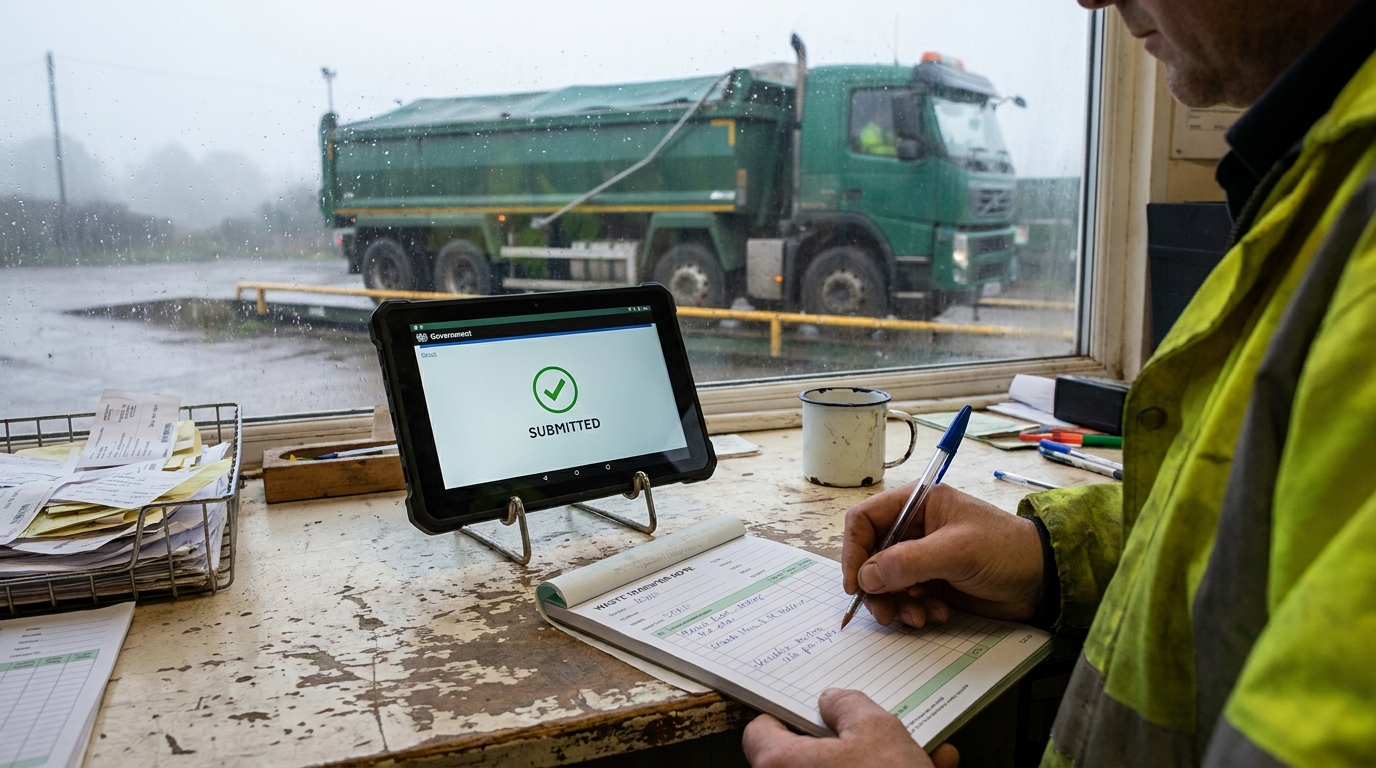
The hopeful question doing the rounds at the weighbridge is a simple one: now that digital waste tracking is live, can the paper finally go in the bin? The duplicate transfer-note pad, the consignment-note carbons, the quarterly returns, the wad of tickets someone keys into a spreadsheet at month end. It would be reasonable to assume a national digital service sweeps all of that away.
It does not. Drop a record the digital service never replaced and you have a plain duty-of-care failure on your hands, which is exactly the gap an EA officer looks for first.
Here is the honest answer, up top, because it is an easy one to get the wrong way round.
No, digital waste tracking does not replace your existing records. It is added on top of them. From 1 October 2026 (England and Wales) you must report every load you receive on the Digital Waste Tracking service, but every paper note and periodic return you file today carries on unchanged. GOV.UK is blunt: "The current paper-based method of tracking waste will initially continue to run alongside the new digital service" (GOV.UK). This is the full inventory of what still has to be filed, how long you keep each record, and the one thing that is genuinely new.
Key takeaways
- Digital is additive, not a replacement. GOV.UK says the paper method "will initially continue to run alongside the new digital service" (GOV.UK).
- Your paper still travels with the load. You "must continue to complete waste transfer notes, Annex VII forms and hazardous waste consignment notes (where required)" (GOV.UK).
- Your periodic returns still go in. Waste returns "in line with the conditions of your environmental permit", and hazardous waste consignee returns which continue "(charges will still apply)" (GOV.UK) — every quarter (GOV.UK).
- The new duty is the digital receipt. You "enter details of every load you receive", and "must submit records within 2 working days (excluding weekends and bank holidays)" (GOV.UK).
- Retention is unchanged: "2 years for non-hazardous waste" and "three years for hazardous waste consignment notes" (GOV.UK).
Does digital waste tracking replace your paper and returns?
No. The service adds a digital record of each receipt; it switches nothing off. GOV.UK puts a fence around this in one sentence: "Until further notice, you must continue to submit the following notes and returns in addition to using the 'Report receipt of waste' service" (GOV.UK). The words doing the work are in addition to.
This is a broader question than the one most people ask first, which is whether the paper waste transfer note specifically survives. It does, and we cover that one in detail in do you still need paper waste transfer notes. But the transfer note is only one line in a longer list. The rest of this guide is the whole list.
What exactly do you still have to file after 1 October 2026?
Everything you file now, in three groups: the notes that travel with each load, the returns you send the regulator on a cycle, and the new digital receipt that lands on top of both.
The first group is unchanged at the gate. GOV.UK says you "must continue to complete waste transfer notes, Annex VII forms and hazardous waste consignment notes (where required)" (GOV.UK). These are completed at the point of transfer and travel with the load, the same as always.
The second group is the one people forget, because it goes in quietly on a cycle rather than at the gate. You "must continue to submit waste returns in line with the conditions of your environmental permit", and you "must also continue to submit hazardous waste consignee returns (charges will still apply)" (GOV.UK). Consignee returns are not occasional: a consignee "must send consignee returns every quarter" to the Environment Agency and to the waste producer or holder (GOV.UK). None of that moves into the digital service.
Your duty-of-care obligations sit underneath all of this and are untouched. If you want to confirm nothing has slipped, the duty of care checklist for a receiving site still applies line for line.
How long do you keep each record?
As long as you always have. Digital waste tracking changes how you report a receipt; it does not shorten a single retention period.
The GOV.UK waste duty of care code of practice is specific. You "must keep a copy of the waste description for waste you have transferred or received", and it lists "2 years for non-hazardous waste" and "three years for hazardous waste consignment notes" (GOV.UK). There is one retention rule that is new to the digital era: if you are digitally excluded and keep a written record instead of submitting online, GOV.UK requires you to "retain the written record for at least 3 years, starting on the date the record is made" (GOV.UK).
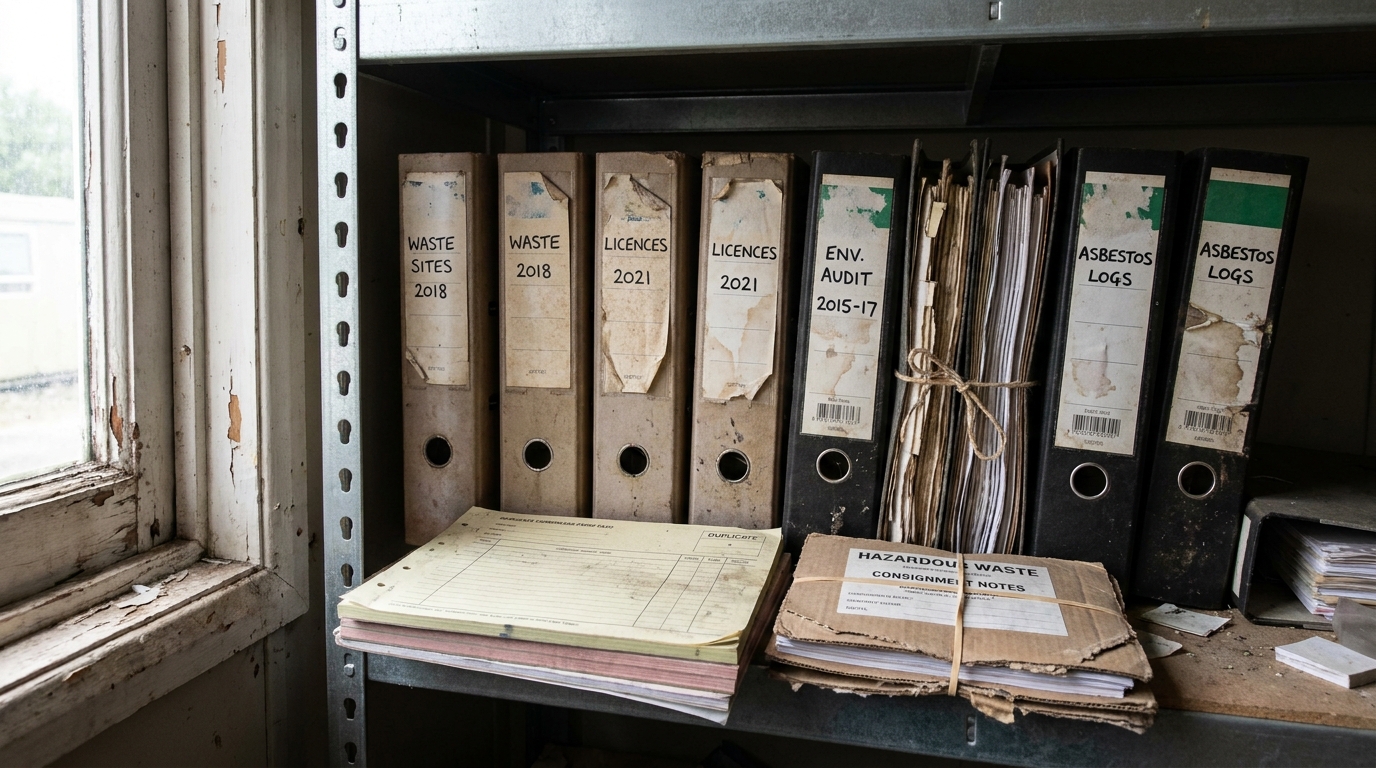
Practically, that means the archive shelf does not get shorter on 1 October. If anything it gets one more thing to hold, because the digital record is one more artefact to be able to produce on request.
What is actually new, and what is the deadline?
One thing is genuinely new: a digital record of every receipt, on a rolling clock. GOV.UK says you "enter details of every load you receive using the 'Report receipt of waste' service", and you "must submit records within 2 working days (excluding weekends and bank holidays)", "starting on the day after you receive the waste" (GOV.UK). A load in on Friday is due by the following Tuesday. It is a daily or every-other-day habit, not a month-end one.
There is a small charge for it. "The service costs £26 per year for each organisation on your account", and "the first payment is due by 31 January 2027" (GOV.UK). You send the data one of two ways: "using an application programming interface (API)" that connects your own system, or "completing and uploading a spreadsheet" (GOV.UK). Which route fits your volume is a real decision, worked through in paper vs the Defra spreadsheet vs software. If the service itself is still new to you, start with what digital waste tracking is.
When does this apply to you?
Your start date is set by the nation you receive waste in, not by "the UK". GOV.UK: "If you receive waste in England or Wales, you must use the service from 1 October 2026" (GOV.UK). For the other two nations it is later: the service becomes mandatory "for receiving site operators in Northern Ireland and Scotland" "from January 2027" (GOV.UK). DAERA confirms it "will become mandatory in Northern Ireland from January 2027" (DAERA), not October 2026.
Scope matters too. Phase 1 is permitted and licensed receiving sites. Waste carriers, brokers and dealers come later: the service is mandatory "for waste collectors" "from October 2027", and "waste exemptions will be included in a later phase" (GOV.UK). If you only hold exemptions, you are not in this first wave.
How do you run paper and digital without doing the work twice?
Capture the load once, and let both records draw from the same details. The failure mode is treating the paper and the digital as two separate jobs done by different people at different times: that is how the two drift apart, and a mismatch between them is exactly what the new service makes visible.
A workable routine is short:
- Record the load once, at the weighbridge — supplier, vehicle, EWC code, tonnage, description — at the one point where the details are known and correct.
- Let the paper note print from that capture, so nothing changes for the driver at the gate.
- File the digital receipt from the same details, inside the 2-working-day window, daily or every other day rather than in a month-end pile.
- Reconcile, do not re-key — at week or month end, check every paper note has a matching digital receipt and every receipt a matching note.
Software built for the weighbridge, such as Yardnote, can file the digital receipt as the load is weighed while the paper note still prints, so the same details feed both records without keying them twice. That is the only point in this guide where a tool helps; everything else is a duty you carry whether you buy anything or not.
Frequently asked questions
Does digital waste tracking replace your existing records?
No. GOV.UK states the current paper-based method "will initially continue to run alongside the new digital service", and that "until further notice, you must continue to submit the following notes and returns in addition to using the 'Report receipt of waste' service" (GOV.UK). It is a duty on top of your paper, not instead of it.
What notes still travel with each load?
The same ones as now. You "must continue to complete waste transfer notes, Annex VII forms and hazardous waste consignment notes (where required)" (GOV.UK). They are completed at the point of transfer and travel with the load exactly as before.
Do I still submit hazardous waste consignee returns?
Yes. GOV.UK says you "must also continue to submit hazardous waste consignee returns (charges will still apply)" (GOV.UK). A consignee "must send consignee returns every quarter" to the Environment Agency and to the waste producer or holder (GOV.UK). The digital receipt does not stand in for the consignee return.
Do I still submit waste returns under my environmental permit?
Yes. You "must continue to submit waste returns in line with the conditions of your environmental permit" (GOV.UK). Digital tracking of receipts is a separate duty from the returns your permit already requires.
What is the one genuinely new thing I have to do?
Report the receipt of every load digitally. You "enter details of every load you receive", and "must submit records within 2 working days (excluding weekends and bank holidays), starting on the day after you receive the waste" (GOV.UK). That rolling clock is the new layer.
How long do I keep non-hazardous waste records?
Two years. The waste duty of care code of practice says you "must keep a copy of the waste description for waste you have transferred or received", and lists "2 years for non-hazardous waste" (GOV.UK). Digital waste tracking does not change this.
How long do I keep hazardous waste consignment notes?
Three years. The same code lists "three years for hazardous waste consignment notes" (GOV.UK). This sits alongside, not instead of, any digital record of the same load. Correct EWC coding on both keeps them defensible at an inspection.
How long do digitally excluded written records last?
At least three years. If you are digitally excluded and keep a written record instead of submitting online, GOV.UK requires you to "retain the written record for at least 3 years, starting on the date the record is made" (GOV.UK).
What does the digital service cost?
"The service costs £26 per year for each organisation on your account", and "the first payment is due by 31 January 2027" (GOV.UK). It is a flat annual charge per organisation, not a per-site or per-load fee.
When does this start for my nation?
England and Wales, "from 1 October 2026" (GOV.UK). Northern Ireland and Scotland, "from January 2027" (GOV.UK); DAERA confirms Northern Ireland is "from January 2027" (DAERA), not October 2026.
What happens if I stop filing the paper too early?
You expose yourself to enforcement for a failure the digital service does not cover. GOV.UK sets out a ladder: a "compliance notice", an "enforcement cost recovery notice", a "variable monetary penalty of an unlimited amount", a "fixed monetary penalty of £1,000", and "criminal prosecution and, if convicted, an unlimited fine". It also warns of "up to 2 years in prison if you knowingly make false or misleading statements or records" (GOV.UK). Keep every stream running until official guidance tells you a specific one can stop.