Do You Still Need Paper Waste Transfer Notes Under Digital Waste Tracking? (Answered)
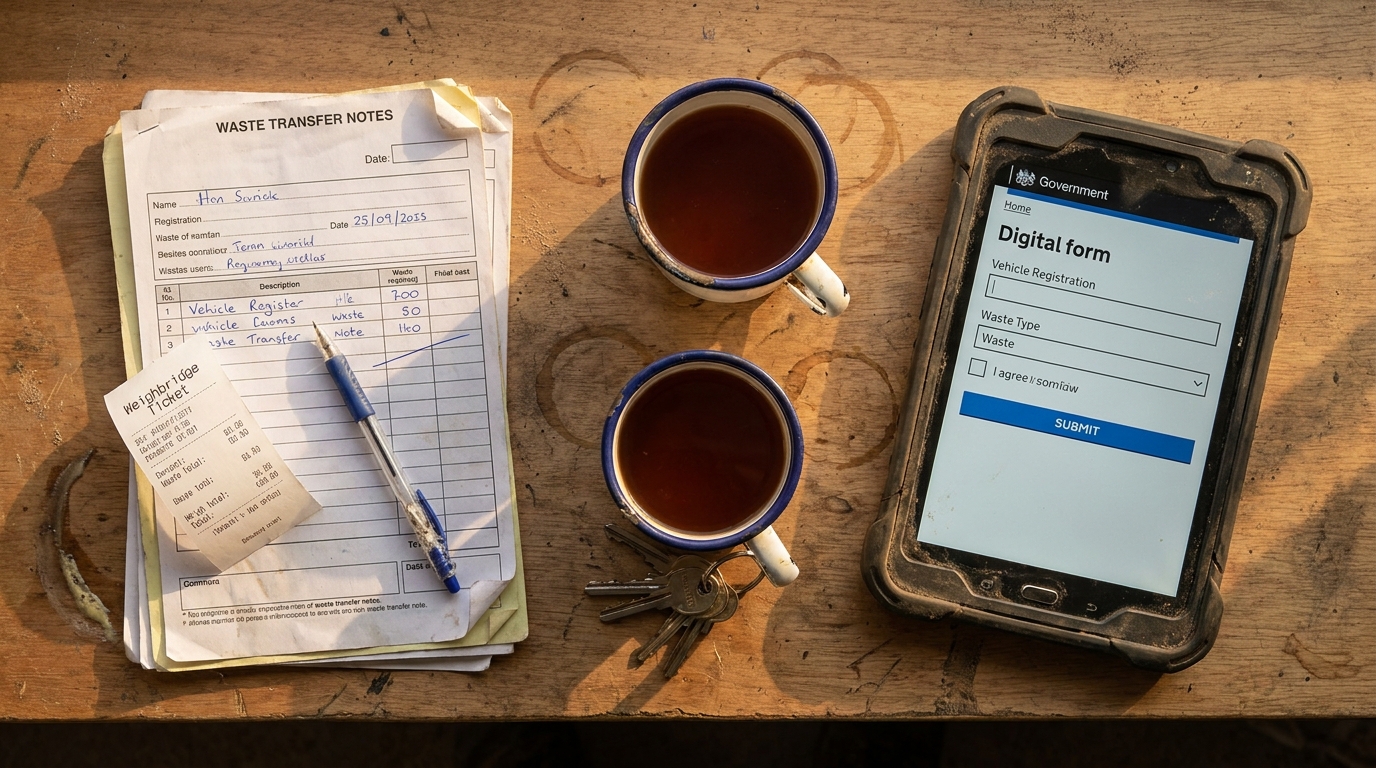
You heard "digital waste tracking" and a small part of you hoped the paper was finally going away. The duplicate transfer note pad, the consignment note carbons, the wad of tickets in the tray that someone keys into a spreadsheet at the end of the month. It would be reasonable to assume a national digital service replaces all that. It does not, and getting this wrong is the sort of mistake an EA officer spots in five minutes.
Here is the honest answer, up top, because it is an easy one to get the wrong way round.
No, digital waste tracking does not replace your paper waste transfer notes in Phase 1. From 1 October 2026 (England and Wales) you must record every load you receive on the Digital Waste Tracking service, but you must also keep completing waste transfer notes, Annex VII forms and hazardous waste consignment notes exactly as you do now. GOV.UK puts it plainly: the paper-based method "will initially continue to run alongside the new digital service" (GOV.UK). Paper runs alongside the digital service, not instead of it.
Key takeaways
- Paper does not stop. You "must continue to complete waste transfer notes, Annex VII forms and hazardous waste consignment notes (where required)" (GOV.UK).
- Digital is a new duty on top. If you are licensed or permitted to receive controlled waste, you "enter details of every load you receive using the 'Report receipt of waste' service" (GOV.UK).
- You have a clock. Records go in "within 2 working days (excluding weekends and bank holidays), starting on the day after you receive the waste" (GOV.UK).
- Your date depends on your nation. England and Wales from 1 October 2026; Scotland and Northern Ireland from January 2027 (GOV.UK).
- Permit returns continue too. You "must continue to submit waste returns in line with the conditions of your environmental permit" (GOV.UK).
What still runs on paper, and what is now digital
The clearest way to hold this in your head is two columns. The left is unchanged. The right is the new duty that lands on top of it on your go-live date.
The digital column does not empty the paper column. It sits on top of it. That is the whole shape of Phase 1.
How do you run paper and digital in parallel without keying everything twice?
The honest worry behind all of this is double work: a busy gate cannot fill in a transfer note and re-type the same load into a digital service every time a lorry tips. You do not have to key it twice. The trick is to capture the load once and let both records draw from the same details.
Here is the routine that keeps the dual-running period manageable:
- Capture once, at the weighbridge. Record the load the moment it is weighed in - supplier, vehicle, EWC code, tonnage, description. That is the single point where the details are known and correct, so it is the point to get them right.
- Let the paper note come off that capture. The transfer note or consignment note the driver needs still prints from the same record, so nothing changes for the driver at the gate.
- File the digital receipt from the same details, inside the window. You "must submit records within 2 working days (excluding weekends and bank holidays), starting on the day after you receive the waste" (GOV.UK), so file the receipt daily or every other day rather than letting a pile build up for month end.
- Reconcile, do not re-key. At week or month end, check that every paper note has a matching digital receipt and every receipt a matching note. A short cross-check catches the load that slipped through before an inspector does.
The failure mode to avoid is treating the paper and the digital as two separate jobs, done by different people at different times - that is how the two records drift apart, and a mismatch between them is exactly what the new service makes visible. If you are still getting to grips with the service itself, our guide to what digital waste tracking is covers what you are reporting and why.
Frequently asked questions
Does digital waste tracking replace waste transfer notes?
No. This is the single most mis-stated point about the whole change, so be certain of it. GOV.UK states the current paper-based method "will initially continue to run alongside the new digital service", and that you "must continue to complete waste transfer notes, Annex VII forms and hazardous waste consignment notes (where required)" (GOV.UK). The word doing the work is "alongside". Nothing on paper is switched off.
What exactly do I still complete on paper?
Everything you complete now. Waste transfer notes for non-hazardous loads, Annex VII forms where they apply, and hazardous waste consignment notes where required (GOV.UK). On top of that you "must continue to submit waste returns in line with the conditions of your environmental permit" (GOV.UK). Your duty of care paperwork is untouched, and the duty of care checklist for a receiving site applies exactly as before.
Do I really have to record the same load twice?
In effect, during this period, yes. You keep the transfer note or consignment note for the load as you always have, and you also enter the receipt of that load into the digital service. GOV.UK is explicit that a permitted receiver must "enter details of every load you receive using the 'Report receipt of waste' service" (GOV.UK). This double handling is exactly why the recording routine matters, covered below.
What is the two-working-day rule?
Each digital record is not due the instant the lorry tips. You "must submit records within 2 working days (excluding weekends and bank holidays), starting on the day after you receive the waste" (GOV.UK). A Friday load, in practice, is due by the following Tuesday. It is a rolling duty, not an end-of-month one, so it needs a daily or every-other-day habit rather than a monthly catch-up.
How long does this dual running last?
There is no published end date, so plan on it continuing until you are told otherwise. GOV.UK uses the word "initially" when it says the paper method will continue to run alongside the service (GOV.UK), which signals it is a transitional arrangement, not the permanent design. The safe operating position is simple: keep the paper going until official guidance says a specific document can stop. Do not read "initially" as "briefly".
When does this start for me, England, Wales, Scotland or Northern Ireland?
Your date is set by your nation, not by "the UK". If you receive waste in England or Wales you "must use the service from 1 October 2026" (GOV.UK). Scotland and Northern Ireland come later: the service is mandatory "from January 2027 – service mandatory for receiving site operators in Scotland and Northern Ireland" (GOV.UK). For Northern Ireland specifically, DAERA confirms it "will become mandatory in Northern Ireland from January 2027" (DAERA). It is an easy mistake to fold Northern Ireland into the October 2026 wave. It is not; it is January 2027. Check your own nation.
What about hazardous waste consignment notes?
They continue where required, the same as your other paper. GOV.UK lists "hazardous waste consignment notes (where required)" among the documents you must keep completing (GOV.UK). The digital receipt of the load does not stand in for the consignment note, and the consignment note does not excuse you from the digital receipt. Both, for now.
What about my permit waste returns?
Also unchanged. You "must continue to submit waste returns in line with the conditions of your environmental permit" (GOV.UK). Digital tracking of receipts is a separate duty from the returns your permit already requires. If your permit says submit a return, you still submit it.
Do I need software, or is the Defra spreadsheet enough?
Both routes are valid. You can send your data by "completing and uploading a spreadsheet", or by "using an application programming interface (API)" that connects your own system to the service (GOV.UK). There is a small annual charge either way: "the annual service charge is £26 per year for each organisation on your account" (GOV.UK). The spreadsheet is a genuine option for a low-volume site. The trade-off is the double keying: a busy weighbridge already captures the load once, so software built for the weighbridge can file the digital receipt inside the two-working-day window while the paper transfer note still prints for the driver. If you are weighing up your options, our DWTS readiness checklist walks through the recording decision step by step.
How long do I keep the records?
Keep them, and keep them a long time. If you are digitally excluded and using the written route, GOV.UK requires you to "retain the written record for at least 3 years, starting on the date the record is made" (GOV.UK). Your existing transfer note and consignment note retention duties sit alongside this, and correct EWC coding on both the paper and the digital record is what keeps them defensible at an inspection.
What happens if I drop the paper too early?
You expose yourself to enforcement for a paperwork failure the digital service does not cover. GOV.UK sets out the ladder for non-compliance (GOV.UK):
- a "compliance notice";
- an "enforcement cost recovery notice";
- a "variable monetary penalty of an unlimited amount";
- a "fixed monetary penalty of £1,000";
- "criminal prosecution and, if convicted, an unlimited fine".
On top of that, it warns of "up to 2 years in prison if you knowingly make false or misleading statements or records" (GOV.UK). Stopping the paper on a hunch that "it's all digital now" is not worth that risk. Run both until the guidance tells you a specific document can go.