What Does an EA Inspection Actually Check? (Answered)

An Environment Agency visit is the moment your permit is put on the line. The fine is rarely the real worry - losing the permit ends the business. And the numbers say the squeeze is tightening: there were 165 persistent poor performers in 2024, up from 141 in 2023 and the highest number since 2016 (Environment Agency Chief Regulator's report 2024-25, 2025). So it pays to know, before the officer arrives, exactly what gets looked at and how what they find turns into a score you have to live with for a year.
This answer page walks through what an EA officer actually examines on the day, how those findings become a Compliance Classification Scheme (CCS) score and an A-F band, and what that band does to your subsistence charge and your permit. It is written for the operator of a permitted waste-receiving site in England. (In Wales your regulator is Natural Resources Wales, in Scotland SEPA, and in Northern Ireland DAERA - the scoring detail below is the EA's.)
Key takeaways
- The EA assesses permit compliance "through activities such as site inspections, site audits" and only scores breaches "that relate directly to permit conditions" (EA CCS guidance, updated 13 October 2026).
- Each non-compliance scores points by risk category (60, 31, 4 or 0.1), and your total over the compliance year (1 January to 31 December) sets your band from A (0 points) to F (more than 150) (EA CCS guidance, 2026).
- Your band sets your subsistence charge: from 95% of the baseline at band A to 300% at band F (EA CCS guidance, 2026).
- Sit in bands D, E or F for two or more consecutive years and you become a "persistent poor performer" - "more likely to have their permit revoked" (EA Chief Regulator's report 2024-25, 2025).
- Your result is no longer private: the EA publishes Compliance Assessment Report (CAR) forms online, with "a holding period of 42 days between a form being written and its appearance online" (R.E.A., 2025).
What is an EA inspection, and why does it matter to your permit?
An EA inspection is how the regulator checks that your site is being run within the conditions of its environmental permit. The Environment Agency "assess[es] permit compliance through activities such as site inspections, site audits" and other checks (EA Chief Regulator's report 2024-25, 2025). It is not a box-ticking courtesy call. What the officer records on the day feeds directly into your compliance score for the year, and that score carries real money and real permit risk behind it.
Inspections happen at a scale most operators underestimate. The EA "completed nearly 22,000 compliance activities for EPR sites in 2024", including "10,573 on-site inspections" (EA Chief Regulator's report 2024-25, 2025). Some are announced, some are not. Either way the officer is looking for the gap between what your permit requires and what your site is actually doing.
What does an EA officer actually check on the day?
There is no single public "EA inspection checklist" document - the officer works from your permit conditions and the appropriate-measures standards for your activity. In practice, at a permitted waste-receiving site the check falls into a handful of areas:
- Your permit and its conditions. The officer starts from what your permit actually allows - waste types, EWC codes, storage limits, throughput - and tests the yard against it.
- Pre-acceptance and acceptance. Are loads being checked against the permitted waste types before they are accepted? Is non-conforming waste being spotted, quarantined and recorded, rather than tipped onto the pile?
- Storage and quarantine. Are you within your permitted storage limits? Are quarantine and non-conforming bays used, bunded where required, and not overflowing?
- Fire prevention and containment. Pile sizes and separation, containment of liquids and firewater, and the controls in your fire prevention plan.
- Record-keeping. Your waste transfer notes, hazardous consignment notes, duty-of-care paperwork and - from 1 October 2026 for permitted receivers in England and Wales - your digital waste tracking records. The officer will ask to see them, and "can't find it" reads as a breach.
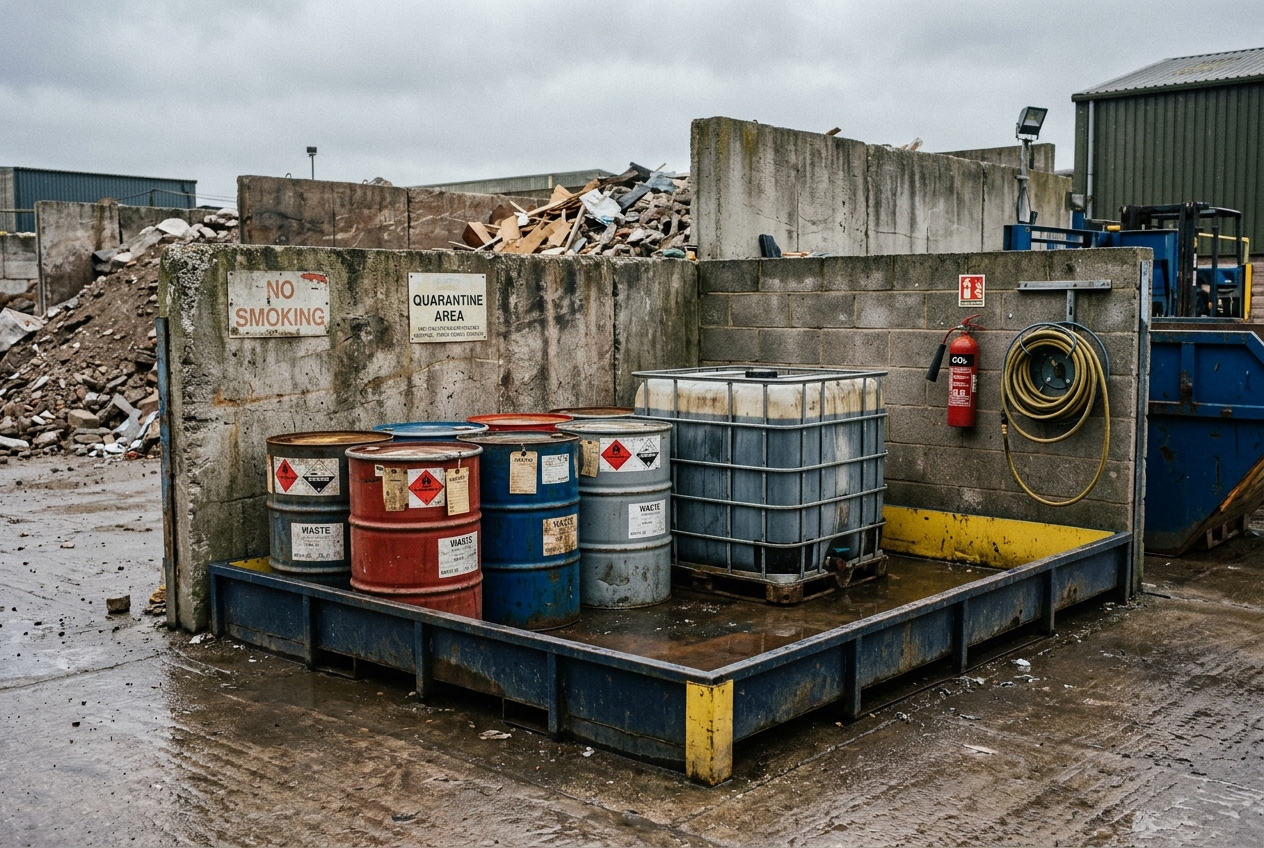
Crucially, not everything that looks untidy counts against you. The EA is explicit: "We only categorise and score non-compliances that relate directly to permit conditions" (EA CCS guidance, updated 13 October 2026). A problem only scores if it breaches a condition of your permit.

Record-keeping is the area most sites lose points on. It is the one that depends on paperwork staying findable for years, rather than on how the yard looks on the day. If a weighbridge slip, a transfer note or a tracking record cannot be produced on request, that is a breach the officer can score - which is why clean, retrievable records matter as much as a tidy yard. (For the paperwork side specifically, see our duty of care checklist for waste sites and what records you still need after digital waste tracking.)
How does the EA turn what it finds into a score?
Every non-compliance the officer records is given a risk category, and each category carries a fixed number of points (EA CCS guidance, 2026):
| Risk category | Points per non-compliance |
|---|---|
| Category 1 (most serious) | 60 |
| Category 2 | 31 |
| Category 3 | 4 |
| Category 4 (least serious) | 0.1 |
You accumulate those points across the compliance year, "which runs from 1 January to 31 December" (EA CCS guidance, 2026). Your running total sets your band:
| Band | Point range |
|---|---|
| A | 0 points |
| B | 0.1 to 10 points |
| C | 10.1 to 30 points |
| D | 30.1 to 60 points |
| E | 60.1 to 149.9 points |
| F | More than 150 points |
The maths has a sharp edge. A single category 1 breach scores 60 points on its own - enough to drop you straight into band D. Two of them tip you into band E. The small stuff (a category 3 at 4 points, a category 4 at 0.1) only mounts up if it is repeated, but the serious breaches move your band in one visit.
What does your compliance band actually cost you?
Your band is not just a label - it sets what you pay. "The subsistence charge is calculated by applying a percentage multiplier to the baseline subsistence charge, based upon the compliance band for the previous year" (EA CCS guidance, 2026). A good year at band A earns a small discount; a bad year at band F triples the bill.
The multipliers run from 95% of the baseline at band A to 300% at band F (EA CCS guidance, 2026). For a site paying a few thousand pounds a year in subsistence, the gap between a band A and a band F year is the difference between a small rebate and a bill three times larger - before you count any enforcement that comes with it.
What happens if you keep scoring badly?
One poor band is a cost. A run of them is an existential threat. "Persistent poor performers are those with permits in bands D, E or F for 2 or more consecutive years", and the EA is blunt that "these sites are more likely to have their permit revoked" (EA Chief Regulator's report 2024-25, 2025).
The enforcement behind that is active, not theoretical. In 2024 the EA "brought 168 prosecution cases, 98 of which resulted in fines totalling £3.8 million" and "issued 295 enforcement notices, almost double that in 2023" (EA Chief Regulator's report 2024-25, 2025). The regulator has also signalled faster action against repeat offenders - the detail of which sits in our guide to what the EA's 10-point plan means for your permit. The point for an operator is simple: the band is the early-warning system, and two bad years is the danger zone.
Can you trust the "97% compliant" figure?
You may have seen the EA headline that the sector is overwhelmingly compliant. It is worth knowing how much weight to put on it, because the officer at your gate works to the same scheme the figure is built on.
The Office for Environmental Protection (OEP) challenged it directly. "The KPI requirement is that 97% of sites should be compliant with their permit", but on the OEP's assessment "the EA can only be confident that around 64% of its sites are compliant" (OEP, 2026). Part of the gap is that uninspected sites were defaulted to the top band: "the EA automatically recorded 29% of sites as falling into the highest category, Band A", despite not having inspected them that year (Clyde & Co, 2026).
The government accepted the criticism. Its September 2026 response states plainly that "the 97% metric is masking underperformance" and that "the Band 'A' default reversion for sites which have not received any inspection needs to be replaced" (Defra government response to the OEP review, 2026). It confirmed the EA "is setting minimum assessment frequencies for different types of waste sites in 2026" and that new performance indicators "will be introduced in 2027" (Defra government response, 2026).
For an operator, the takeaway is practical: the days of a quiet default band A for a site that never saw an inspector are ending. Expect more inspections, and expect the band you earn to be the band you actually earned.
Can anyone see your inspection result now?
Yes - and this is a recent change many operators have missed. CAR forms "for permitted sites are public register information and have always been available for inspection upon request", but the EA now publishes them online: "the EA will publish forms written from 18 August 2025 onwards", with "a holding period of 42 days between a form being written and its appearance online" (R.E.A., 2025). As of April 2026, "more than 8,000 waste and installations CAR forms have been published" (Defra government response, 2026).
In practice that means your inspection write-up - breaches and all - can end up visible to neighbours, competitors and customers within six weeks. The 42-day window is also your chance to read the form and raise any factual error before it goes live.
How should you get ready?
The best preparation is to inspect yourself the way the officer will: against your permit conditions, with your records in reach. Walk the pre-acceptance and quarantine process, check your storage limits and fire controls, and - the one most sites trip on - make sure every transfer note, consignment note and tracking record can be produced in seconds, not dug out of a lever-arch file after the officer has left.
That record-keeping job is where the right tool earns its keep: software built for the weighbridge can record each load once and keep the paper trail retrievable, so a "show me your records" request is answered on the spot rather than becoming a scored breach. Yardnote is one such option for permitted UK sites.
For the step-by-step prep and the items to have ready, see our guide to preparing for an EA inspection and the EA inspection checklist for waste sites.
Frequently asked questions
What does an EA inspection check at a waste site?
An officer checks your site against your environmental permit conditions: permitted waste types and EWC codes, pre-acceptance and acceptance checks, storage limits and quarantine, fire prevention and containment, and your records. Only breaches that "relate directly to permit conditions" are scored (EA CCS guidance, 2026).
Does the EA give advance notice of an inspection?
Not always. Site inspections are one of the activities the EA uses to assess compliance, and they can be announced or unannounced (EA Chief Regulator's report 2024-25, 2025). Run the site as if the officer could arrive today.
How is an EA compliance score calculated?
Each non-compliance is given a risk category worth 60, 31, 4 or 0.1 points. Your total over the compliance year (1 January to 31 December) sets your band, from A at 0 points to F at more than 150 points (EA CCS guidance, 2026).
What is a good compliance band?
Band A (0 points) is the best. Bands A, B and C are generally treated as compliant; D, E and F signal problems. One category 1 breach alone scores 60 points and drops you into band D (EA CCS guidance, 2026).
How does my compliance band affect my permit fees?
Your band sets a percentage multiplier on your baseline subsistence charge for the next year: 95% at band A, 100% at B, 110% at C, 125% at D, 150% at E and 300% at F (EA CCS guidance, 2026).
Can the EA revoke my permit over a bad score?
A single bad band will not, on its own. But sites in bands D, E or F for two or more consecutive years are "persistent poor performers" and are "more likely to have their permit revoked" (EA Chief Regulator's report 2024-25, 2025).
Is the EA's "97% compliant" figure reliable?
The OEP found the EA "can only be confident that around 64% of its sites are compliant", and the government agreed "the 97% metric is masking underperformance" (OEP, 2026; Defra government response, 2026). Expect more inspections and tighter scoring.
Are EA inspection results made public?
Yes. The EA publishes CAR forms written from 18 August 2025 onwards, after "a holding period of 42 days" (R.E.A., 2025). More than 8,000 waste and installations forms had been published by April 2026 (Defra government response, 2026).
What records does an EA officer want to see?
Your waste transfer notes, hazardous consignment notes, duty-of-care paperwork and digital waste tracking records. A record you cannot produce on request can be scored as a breach. See our duty of care checklist for the full list.
Which regulator inspects my site?
In England it is the Environment Agency. In Wales it is Natural Resources Wales, in Scotland SEPA, and in Northern Ireland DAERA. The CCS scoring described here is the EA's scheme for England.