What Is Duty of Care for Waste? A Guide for UK Waste Site Operators

Ask ten yard operators what the duty of care is and you will get ten answers. Most will point at the waste transfer note. The note is part of it, but the duty of care is bigger and older than any form. It is the legal thread that makes you answerable for waste from the moment it reaches your site to the moment it lawfully leaves. Waste crime costs the UK economy an estimated £1bn each year (Environment Agency, 2026), and the duty of care is the law built to keep that waste traceable and in responsible hands.
This guide is the reference layer, not a to-do list. It sets out what the duty is, where it comes from, who it lands on, and how it connects to the permit, the transfer note, the EWC code and Digital Waste Tracking. For the step-by-step version you work through on each load, see our duty of care checklist.
Key takeaways
- The duty of care is the legal duty in section 34 of the Environmental Protection Act 1990 on anyone who keeps, treats or controls waste to handle it responsibly. It is a concept, not a single form (legislation.gov.uk, 1990).
- It applies to your receiving site by capacity: because you keep, treat and control waste, you must take "all such measures applicable to him in that capacity as are reasonable in the circumstances" (legislation.gov.uk, 1990).
- It breaks into three duties: prevent the waste escaping, transfer it only to an authorised person, and send a written description with it (legislation.gov.uk, 1990).
- The Waste Duty of Care Code of Practice is statutory guidance issued under s.34 and applies in England and Wales (gov.uk, 2016).
- Digital Waste Tracking adds a reporting layer on top of the duty; it does not replace it. It becomes mandatory from 1 October 2026 in England and Wales and January 2027 in Scotland and Northern Ireland (gov.uk, 2026; NetRegs, 2026).
What is the duty of care for waste?
The duty of care is the legal requirement to look after waste responsibly for as long as you hold it and when you pass it on. It is set out in section 34 of the Environmental Protection Act 1990, which places a duty on "any person who imports, produces, carries, keeps, treats or disposes of controlled waste or, as a dealer or broker, has control of such waste" (legislation.gov.uk, 1990). It is the backbone of the whole chain-of-custody system: each holder is accountable for the waste while it is theirs, and for handing it on correctly.
"Controlled waste" is the waste the duty covers. Section 75 defines it plainly: "household, industrial and commercial waste or any such waste" (legislation.gov.uk, 1990). For a scrap yard, transfer station or treatment facility, almost everything across the weighbridge is controlled waste, so the duty is in play on effectively every load.
Who does the duty of care apply to?
It applies to your site directly, and it always has. The duty is not just on the producer who skips the waste or the carrier who hauls it. It lands on anyone who keeps, treats or controls waste, which is exactly what your site does the moment a tipper backs onto the pad. The law frames this as a capacity test: you must take "all such measures applicable to him in that capacity as are reasonable in the circumstances" (legislation.gov.uk, 1990).

That phrase matters. "In that capacity" means the duty is measured against what a reasonable operator in your position would do, not against a householder's. You run a permitted site with staff, a weighbridge and records, so more is expected of you than of the person who dropped the waste off. The duty is proportionate, but for a professional receiving site the bar sits high.
What are the three duties section 34 actually imposes?
Section 34 turns the general duty into three concrete obligations. Each one is a thing you must achieve on every transfer, and together they are what an Environment Agency officer is really checking.
Prevent the waste escaping. You must "prevent the escape of the waste from his control or that of any other person" (legislation.gov.uk, 1990). In practice that is containment, security and housekeeping, so waste does not blow off the pile, leak off the pad or walk off the site.
Transfer only to an authorised person. On transfer you must secure "that the transfer is only to an authorised person or to a person for authorised transport purposes" (legislation.gov.uk, 1990). An authorised person is defined in s.34(3): a waste collection authority, the holder of a waste management licence (now an environmental permit), or a person registered as a carrier of controlled waste, among others (legislation.gov.uk, 1990). For a carrier taking waste off your site, that means a valid entry on the waste-carrier public register (Environment Agency).
Send a written description with it. You must secure "that there is transferred such a written description of the waste as will enable other persons to avoid a contravention" of the law (legislation.gov.uk, 1990). The test is purpose, not paperwork: the description has to be good enough for the next holder to handle the waste lawfully. "Mixed metal" is not a description. What the waste is, the process it came from, its EWC code and any hazardous properties are.
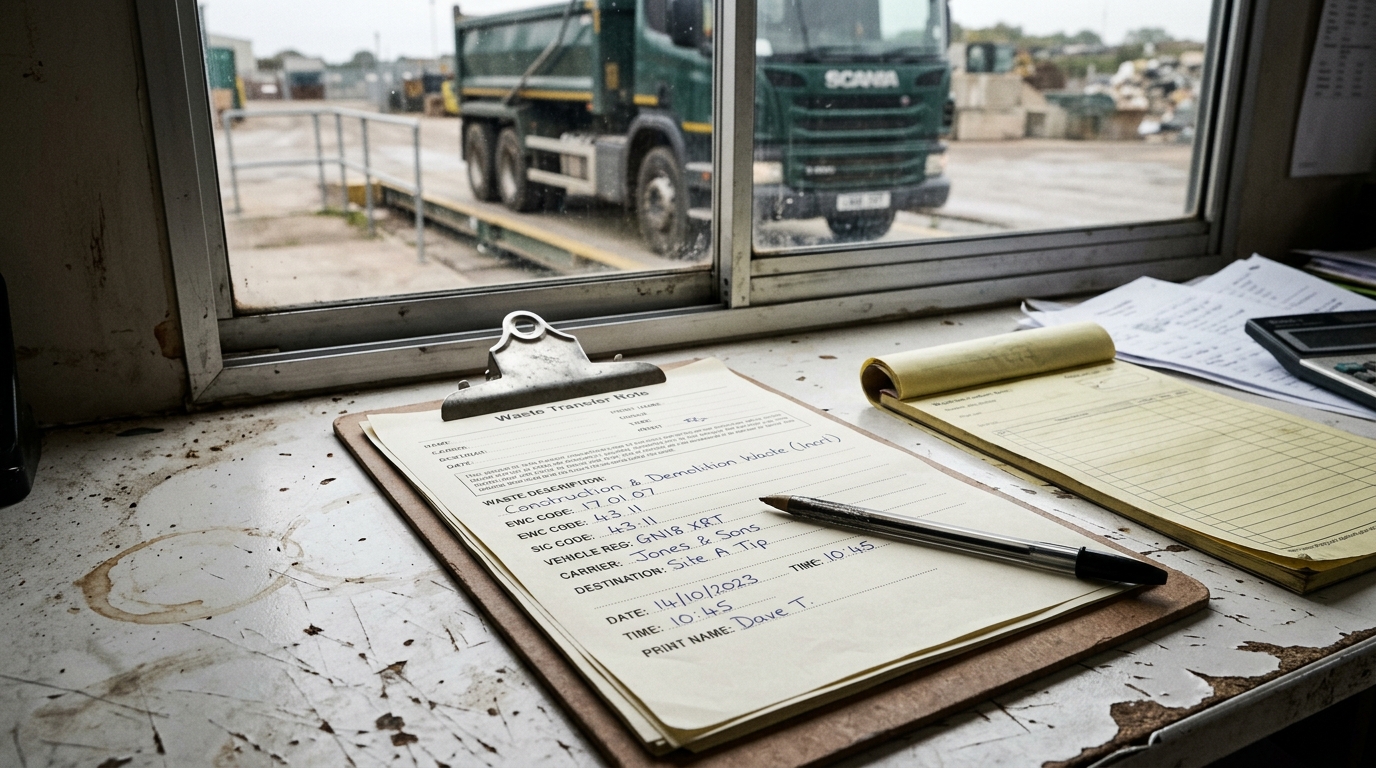
The written description is the one obligation that produces a document. That document is usually a waste transfer note for non-hazardous waste, or a hazardous waste consignment note where the load is hazardous.
Is the Waste Duty of Care Code of Practice legally binding?
It is statutory guidance, which sits between law and advice. The Code is "issued under section 34 of the Environmental Protection Act 1990" and applies to anyone who handles waste "in England or Wales" (gov.uk, 2016). It does not create new offences, but it sets out how to meet the duty, and it is the standard a regulator and a court will measure you against. First published on 11 March 2016, it is the practical reference behind the bare words of s.34 (gov.uk, 2016).
Treat the Code the way you treat an approved code of practice on site safety: not every line is a legal command, but departing from it without a good reason is hard to defend when someone asks why.
How does the duty of care relate to your permit, WTNs, EWC codes and DWTS?
This is where operators get tangled. The duty of care is not the same thing as your permit or your transfer note. It is the foundation they all rest on. Your environmental permit authorises the activity at your site and sets its conditions. The duty of care is the separate, overarching obligation to handle waste responsibly wherever it goes. You can hold a valid permit and still breach the duty of care, and vice versa.
The other records are how you evidence the duty, each doing one job. The EWC code classifies the waste so the description is portable across the chain. The transfer note or consignment note is the written description in documentary form, signed by both parties. The carrier check proves you transferred only to an authorised person. And Digital Waste Tracking is the newest layer: a digital report of the movement, sitting on top of all of it.
Crucially, DWTS does not replace the duty. Gov.uk is explicit that you must "continue to complete waste transfer notes, Annex VII forms and hazardous waste consignment notes (where required)" and "continue to submit waste returns in line with the conditions of your environmental permit" (gov.uk, 2026). Software built for the weighbridge can capture the carrier check and the written description as the load is weighed, so the duty-of-care evidence is kept once and used everywhere, rather than rekeyed into a separate system.
Does the duty of care work the same across the UK?
The core duty under s.34 runs across Great Britain, but the detailed guidance and the reporting timetable are devolved. The Waste Duty of Care Code of Practice applies in England and Wales (gov.uk, 2016); Northern Ireland and Scotland have their own equivalent codes. The practical duty is the same everywhere: describe the waste, check the carrier, keep the records.
Digital Waste Tracking is where the dates diverge, and it is easy to overstate. For sites receiving waste in England or Wales, "you must use the service from 1 October 2026" (gov.uk, 2026). For Scotland and Northern Ireland, the public beta "becomes mandatory in January 2027" (NetRegs, 2026). Never tell your Scottish or Northern Irish contacts they must be live by October 2026, and never say "the UK" has a single deadline.
What does getting the duty of care wrong cost?
Two penalties sit behind the duty, and they work at different scales. The smaller, direct one is a fixed penalty: where a person "has failed to comply with a duty to furnish documents" to an enforcement authority, "the fixed penalty payable to an enforcement authority under this section is, subject to subsection (10) below, £300" (s.34A) (legislation.gov.uk, 1990). It lands for the simplest failure of all: paperwork you cannot produce on the day.
The larger one is the general offence. Failing to comply with the s.34(1) duty is punishable "on summary conviction, to a fine not exceeding the statutory maximum" and "on conviction on indictment, to a fine" with no upper limit stated (legislation.gov.uk, 1990). In other words, a serious duty-of-care breach can draw an unlimited fine in the Crown Court.
For most operators, though, the real cost is neither fine. A duty-of-care gap found at an EA inspection is written up on the compliance assessment report, rolls into your annual compliance band, and quietly raises next year's permit charge. A clean duty-of-care trail is the cheapest way to keep an inspection a conversation rather than an enforcement notice.
Frequently asked questions
What is the duty of care for waste in simple terms? It is the legal requirement to handle waste responsibly: keep it secure, pass it only to someone authorised to take it, and send an accurate written description with it (legislation.gov.uk, 1990).
Where does the duty of care come from? From section 34 of the Environmental Protection Act 1990, with the detail set out in the statutory Waste Duty of Care Code of Practice (legislation.gov.uk, 1990; gov.uk, 2016).
Does the duty of care apply to my receiving site or just the producer? It applies to your site. The duty falls on anyone who keeps, treats or has control of waste, which is exactly what you do once a load is tipped on your pad (legislation.gov.uk, 1990).
What is "controlled waste"? Section 75 defines it as "household, industrial and commercial waste or any such waste" (legislation.gov.uk, 1990). Nearly everything a permitted site receives is controlled waste.
Who is an "authorised person"? Section 34(3) lists them, including a waste collection authority, the holder of a waste management licence (now an environmental permit), and a registered carrier of controlled waste (legislation.gov.uk, 1990). For an outgoing load, that usually means a registered waste carrier.
What makes a "written description" compliant? It must be good enough to let the next holder avoid breaking the law, so it names what the waste actually is, the process it came from, its EWC code and any hazardous properties (legislation.gov.uk, 1990).
Is the Waste Duty of Care Code of Practice legally binding? It is statutory guidance issued under s.34 and applies in England and Wales. It does not create offences, but a regulator and a court will measure you against it (gov.uk, 2016).
How is the duty of care different from my environmental permit? The permit authorises the activity at your site and sets its conditions. The duty of care is the separate, overarching obligation to handle waste responsibly throughout the chain. You can breach one without breaching the other (legislation.gov.uk, 1990).
Does Digital Waste Tracking replace the duty of care? No. You must continue to complete transfer notes, Annex VII forms and hazardous waste consignment notes where required, and keep submitting your permit returns. DWTS is a reporting layer on top of the duty (gov.uk, 2026).
What does breaching the duty of care cost? Failing to furnish the waste documents an enforcement authority asks for carries a £300 fixed penalty under s.34A, while a conviction on indictment for breaching the duty itself can draw an unlimited fine (legislation.gov.uk, 1990; legislation.gov.uk, 1990).
Is the duty of care the same in Scotland and Northern Ireland? The core s.34 duty is, but the codes of practice and the Digital Waste Tracking dates differ: DWTS is mandatory in England and Wales from 1 October 2026 and in Scotland and Northern Ireland from January 2027 (gov.uk, 2026; NetRegs, 2026).