What Is a Waste Transfer Note? A Guide for UK Waste Site Operators
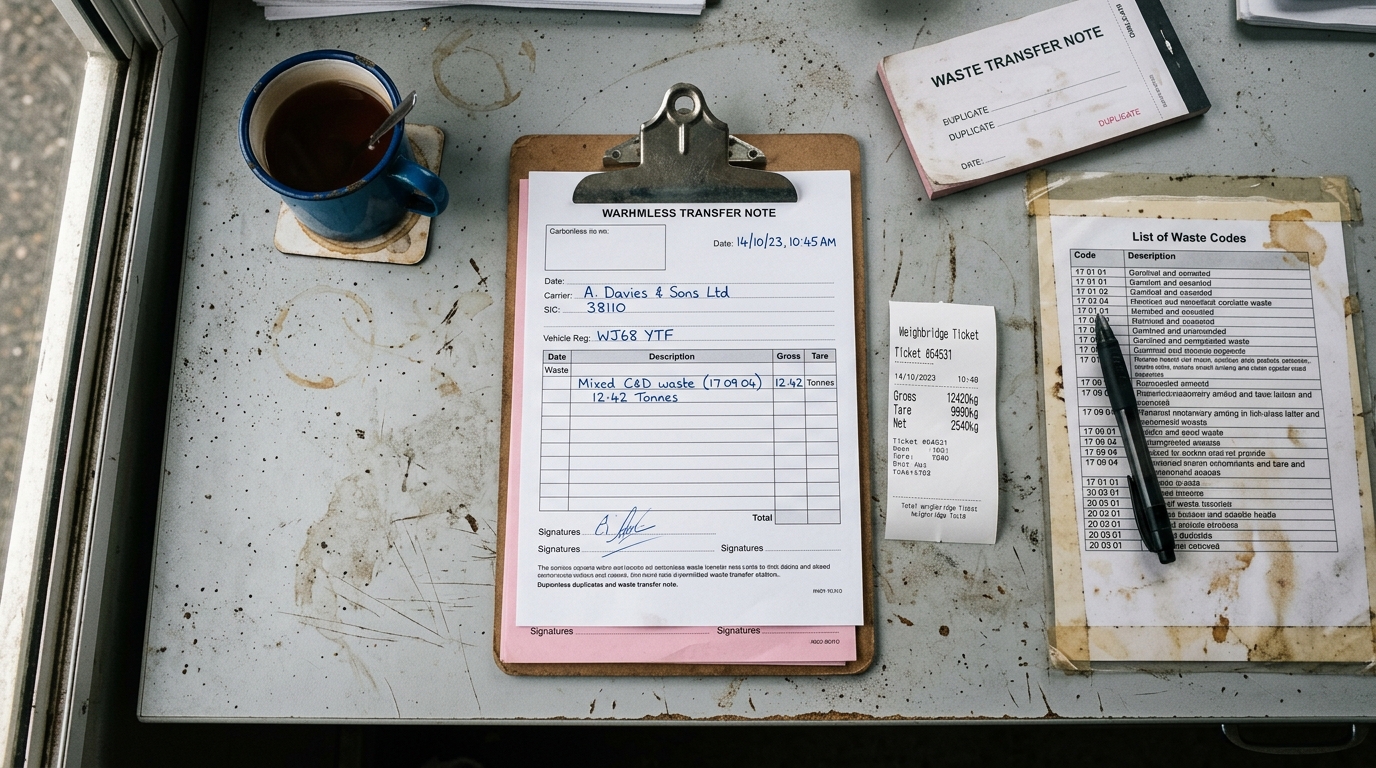
Every load that tips on your site should leave a piece of paper behind it - the waste transfer note that records what the waste was, who handed it over, and that both sides did their bit. Skip it, or lose it, and you are the one exposed. The Environment Agency can issue a £300 fixed penalty to anyone who fails to furnish the transfer documentation it asks for: "The fixed penalty payable to an enforcement authority under this section is, subject to subsection (10) below, £300" (legislation.gov.uk, 1990). Behind the note sits the duty of care - a criminal offence to breach, not a paperwork nicety.
On a busy weighbridge, with a queue of tippers and your operator keying loads between drivers, the transfer note is easy to treat as a formality. It is not. So it is worth being clear on what the note actually is, what it has to say, and how long you are on the hook for it.
What is a waste transfer note?
A waste transfer note (WTN) is the written record that must accompany every transfer of non-hazardous controlled waste between two parties, showing that each side has met its duty of care. That duty comes from section 34 of the Environmental Protection Act 1990, which requires anyone who imports, produces, carries, keeps, treats or disposes of controlled waste to "take all such measures applicable to him in that capacity as are reasonable in the circumstances", and on transfer to secure "that there is transferred such a written description of the waste as will enable other persons to avoid a contravention of that section" (legislation.gov.uk, 1990).
That "written description" is the transfer note. It travels with the load, and it is the document your site relies on to prove where the waste came from and that you were entitled to take it. For a permitted receiving site, the WTN is one of three things your operator reconciles at the gate: the description on the note, the EWC (List of Waste) code that classifies it, and the weight on the weighbridge ticket. Get those to agree and the load is clean. Let them drift apart and you have a duty-of-care problem down the chain.
Key takeaways
- A waste transfer note is the written description of the waste that must accompany every transfer of non-hazardous controlled waste, evidencing duty of care under s.34 of the Environmental Protection Act 1990 (legislation.gov.uk, 1990).
- The note must identify the waste by its List of Waste (EWC) code, state the quantity and container, the time and place of transfer, the parties, and confirm the transferor has applied the waste hierarchy (legislation.gov.uk, 2011).
- Keep a waste transfer note for two years - "Keep a paper or electronic copy for 2 years" (GOV.UK).
- Hazardous waste uses a consignment note, not a transfer note, and the records are kept for three years (legislation.gov.uk, 2005).
- Under digital waste tracking, the paper "will initially continue to run alongside the new digital service" in Phase 1 - so you still complete the WTN (GOV.UK).
What must a waste transfer note contain?
A transfer note has to carry enough detail for the next holder to handle the waste lawfully. Regulation 35 of the Waste (England and Wales) Regulations 2011 sets the list: the note must "identify the waste to which it relates by reference to the appropriate codes in the List of Wastes", give "its quantity and whether it is loose or in a container" and "the kind of container", state "the time and place of transfer, and the SIC code of the transferor", give "the name and address of the transferor and the transferee and be signed by them", and "confirm that the transferor has discharged the duty in regulation 12" - the duty to apply the waste hierarchy (legislation.gov.uk, 2011).
The regulator's plain-English version lists the same fields, and is explicit that the note carries both "the appropriate European Waste Catalogue (EWC) code for your waste" and "the Standard Industry Code (SIC) of your business" (NetRegs).
The practical point for a receiving site: those fields are what your operator checks the load against. If the description says "mixed construction waste" but the tipper is full of plasterboard, or the EWC code on the note does not match what is actually coming off the back, the note is wrong before it reaches your file - and correcting it later is far harder than querying it at the gate.
What is the difference between a waste transfer note and a consignment note?
A waste transfer note covers non-hazardous waste. Hazardous waste uses a consignment note instead - a different form, with a different retention period and a different regime behind it. If a load is hazardous, the transfer note is the wrong document.
| Waste transfer note | Hazardous consignment note | |
|---|---|---|
| Covers | Non-hazardous controlled waste | Hazardous waste |
| Triggered by | Any non-hazardous transfer | A List of Waste code with an asterisk (*) |
| Keep for | 2 years | 3 years |
Sources: GOV.UK; Hazardous Waste (England and Wales) Regulations 2005, reg 49.
This is where the EWC code earns its keep: the asterisk on a List of Waste code is what tells your operator the waste is hazardous and needs a consignment note, not a transfer note. Misread that at the gate and you have paperwork that does not match the load - exactly the kind of mismatch an EA officer looks for.
The retention duties differ too, and it is worth keeping them straight.
How long do you have to keep a waste transfer note?
Keep a waste transfer note for two years. GOV.UK is blunt about it: "Keep a paper or electronic copy for 2 years" (GOV.UK).
Hazardous waste is different. Records tied to a hazardous consignment must be preserved for longer - three years. The Hazardous Waste (England and Wales) Regulations 2005 require records to be kept "while the person is a holder of the waste or (if not a holder) has control of the waste; and for 3 years after the date on which the waste is transferred to another person" (legislation.gov.uk, 2005).
Two years does not sound long until you count the tickets. A busy transfer station raises a note for every load it takes in, and every one has to be findable if the EA asks - which is why the retention duty, not the note itself, is what quietly eats an afternoon at month-end.
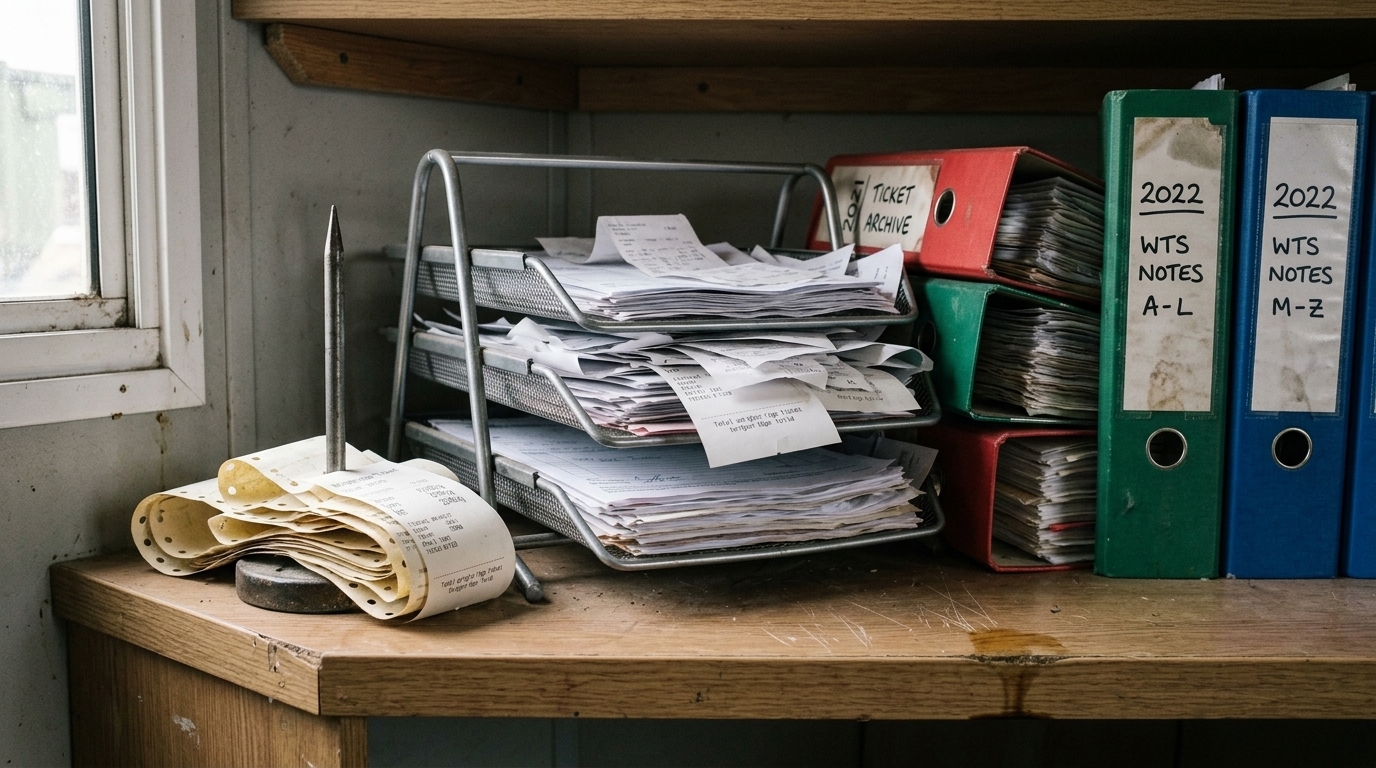
Two years of paper is two years of shelf space, lost tickets, and the risk that the one note an officer wants is the one that went missing. That storage duty is the same whether you keep the note on paper or as an electronic copy - the regulations allow either.
What is a season ticket for waste transfer notes?
A season ticket is a single transfer note that covers repeat transfers of the same non-hazardous waste, so you do not raise a fresh note every time. GOV.UK lets you use one to cover "multiple transfers of non-hazardous waste over a period of up to a year" - handy where you take the same waste, from the same carrier, on a regular round (GOV.UK).
The catch is that the details have to hold still. The current holder of the waste, the waste carrier and the type of waste must stay the same for the whole period; change any of them and the season ticket no longer covers the transfer. And the retention duty still applies to the arrangement: "You must keep your season ticket and schedule for 2 years after the last waste transfer" (GOV.UK).
For a receiving site with regular trade suppliers, a season ticket cuts the paper. It does not cut the checking - the load still has to match the description on the ticket every time it arrives.
Do you still need a waste transfer note under digital waste tracking?
Yes. From 1 October 2026, permitted sites that receive waste in England and Wales must record movements through the new digital waste tracking service: "If you receive waste in England or Wales, you must use the service from 1 October 2026" (GOV.UK). Scotland and Northern Ireland follow, with the service becoming "mandatory from January 2027 in Northern Ireland and Scotland" (NetRegs).
But digital tracking does not switch the paper off. In Phase 1, "the current paper-based method of tracking waste will initially continue to run alongside the new digital service. This means you must continue to complete waste transfer notes, Annex VII forms and hazardous waste consignment notes (where required)" (GOV.UK). So you run both: the note stays, and a digital receipt goes on top. Receivers must submit each record "within 2 working days (excluding weekends and bank holidays), starting on the day after you receive the waste" (GOV.UK).
That two-day clock is the new bit of work, and it lands on the same operator already reconciling the note against the weighbridge ticket. The detail worth knowing is that you still complete the paper transfer note alongside the digital record - so the same load data now has to be captured twice, once on the note and once in the digital submission. Software built for the weighbridge can record the load once and file the receipt from the same entry, so the note and the digital record come from a single keystroke rather than two.
What happens if you do not have a valid waste transfer note?
Two things bite. First, the duty of care itself: failing to secure a proper written description of the waste on transfer is a breach of s.34, and duty of care is a criminal duty, not a courtesy. A duty-of-care check that starts with the transfer note is the cheapest insurance a site has.
Second, the fixed penalty. Where you fail to furnish the transfer documentation an enforcement authority requires, it can issue a fixed penalty of £300 (legislation.gov.uk, 1990). That is the floor, not the ceiling - the real cost of a paperwork trail that does not stand up is the questions it invites at your next inspection, and the enforcement action that follows a pattern of them.
None of that is exotic. It comes down to the note being complete, matching the load, and being findable for two years. Get that right at the gate and the rest looks after itself.
Frequently asked questions
What is a waste transfer note in simple terms?
It is the written record that has to accompany a transfer of non-hazardous controlled waste, describing the waste and showing both parties met their duty of care (legislation.gov.uk, 1990).
What information must be on a waste transfer note?
A description of the waste, its List of Waste (EWC) code, the quantity and container, the time and place of transfer, the SIC code of the transferor, the names, addresses and signatures of both parties, and confirmation the transferor has applied the waste hierarchy (legislation.gov.uk, 2011).
How long do I have to keep a waste transfer note?
Two years. GOV.UK says to "keep a paper or electronic copy for 2 years" (GOV.UK).
Is a waste transfer note the same as a consignment note?
No. A transfer note is for non-hazardous waste; hazardous waste uses a consignment note, and those records are kept for three years (legislation.gov.uk, 2005).
Do I need a waste transfer note for every load?
For each transfer of non-hazardous waste, yes - unless a season ticket covers repeat transfers of the same waste, from the same carrier, over up to a year (GOV.UK).
What is a season ticket for waste transfer notes?
A single note covering multiple transfers of the same non-hazardous waste over a period of up to a year, provided the holder, carrier and waste type stay the same (GOV.UK).
Can a waste transfer note be electronic?
Yes. GOV.UK allows you to keep "a paper or electronic copy", so an electronic note and electronic storage are both acceptable (GOV.UK).
Does digital waste tracking replace waste transfer notes?
Not in Phase 1. The paper "will initially continue to run alongside the new digital service", so you complete the note and submit the digital record (GOV.UK).
When does digital waste tracking become mandatory?
For receivers in England and Wales, from 1 October 2026; for Northern Ireland and Scotland, from January 2027 (GOV.UK; NetRegs).
What is the penalty for not having a valid waste transfer note?
An enforcement authority can issue a fixed penalty of £300 for failing to furnish the required transfer documentation, on top of the underlying duty-of-care offence (legislation.gov.uk, 1990).