The Lithium-Battery Fire-Risk Checklist for Waste Receiving Sites
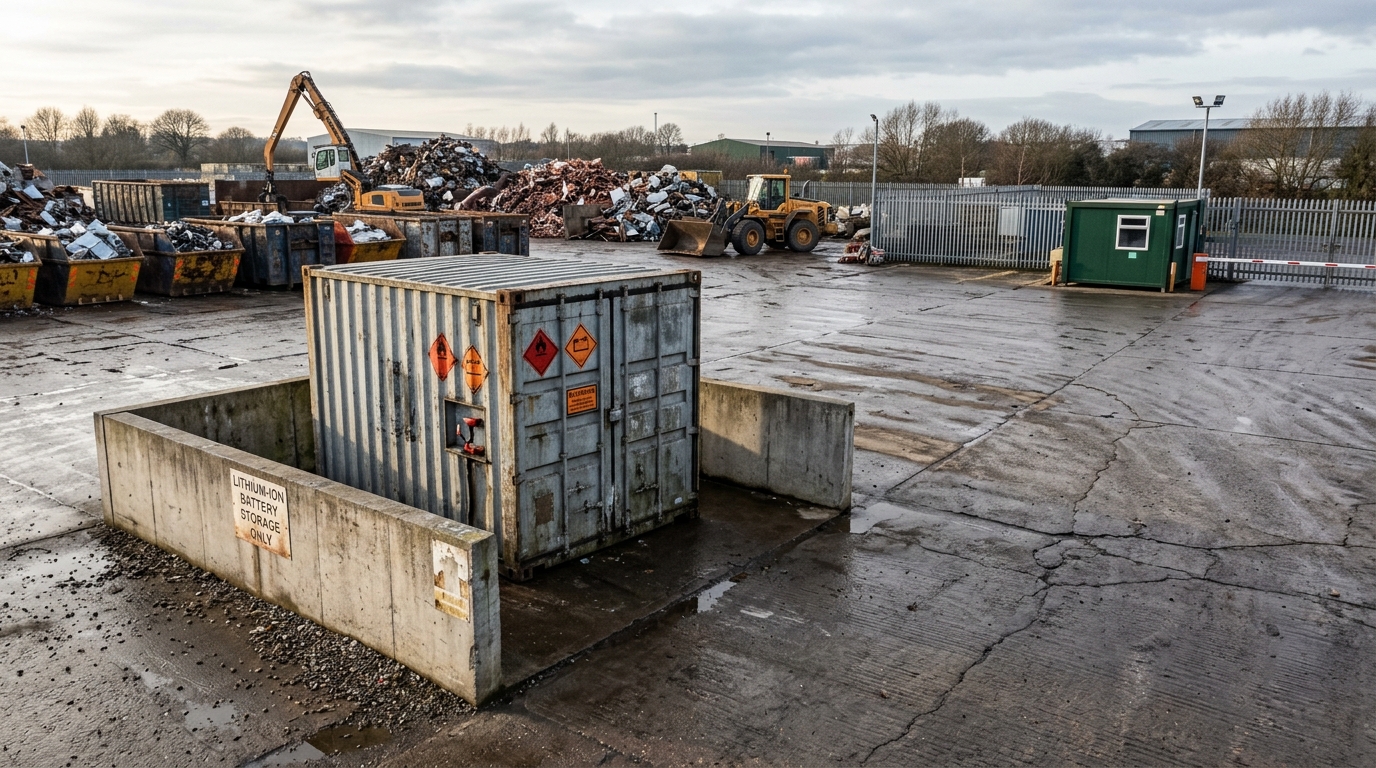
The battery that burns your site down never arrives declared. It comes in hidden inside a mixed load: a power tool pack in a skip of C&D waste, a disposable vape in a bag of general waste, a phone battery in a bin lorry's tipping. Then it gets crushed by a grab or a loader bucket, goes into thermal runaway, and you have a fire in the pile before anyone has seen a flame.
This is not a rare event any more. There were over 1,200 battery fires in bin lorries and at waste sites across the UK in a single year, an increase of 71% from 700 in 2022 (Material Focus, 2024). The Environmental Services Association now calls the problem "epidemic levels" and says these incidents are "costing the UK over £1 billion annually" (letsrecycle, 2025).
For a permitted receiving site, a battery fire is not just a bad day. It is a permit risk, an insurance risk and a business-continuity risk all at once. This checklist runs the routine that cuts the ignition sources before they reach the pile: screen at the gate, catch on the line, segregate and quarantine, and be ready for the incident.
Key takeaways
- Battery fires in UK bin lorries and at waste sites hit over 1,200 in a single year, up 71% from 700 in 2022 (Material Focus, 2024).
- The ESA puts the cost at "over £1 billion annually" and says lithium-ion batteries are "behind almost half of all waste fires in the UK" (letsrecycle, 2025).
- Your Fire Prevention Plan must "minimise the likelihood of a fire happening", "aim for a fire to be extinguished within 4 hours" and "minimise the spread of fire within the site and to neighbouring sites" (gov.uk, 2021).
- A plan is required if you store combustible waste, and "if you do not put in place and use your fire prevention measures, the Environment Agency may take enforcement action" (gov.uk, 2021). In Wales, Natural Resources Wales requires an equivalent fire prevention and mitigation plan (Natural Resources Wales).
- Real incidents show the pattern: at Brentford in March 2025 and Beckton in December 2025, the London Fire Brigade found "the most probable cause of the fire was the failure of a lithium-ion battery" (London Fire Brigade, 2025).
Why are lithium batteries such a fire risk at your site?
Because the hazard is invisible until it is too late. A lithium-ion cell stores a lot of energy in a small package. Crush it, puncture it or let it get wet and short, and it can go into thermal runaway: a self-heating reaction that vents flammable gas and ignites, hard to cool and hard to put out.
On a receiving site the danger is the volume of material around it. One failed vape in a bale, a skip or a tipping pile sits surrounded by cardboard, plastic and timber. The ESA estimates lithium-ion batteries are "behind almost half of all waste fires in the UK" (letsrecycle, 2025).
The incident reports make it concrete. At a waste recycling site on Transport Avenue, Brentford, in March 2025, "around 100 square metres of scrap metal and electrical waste was alight" and the brigade found "the most probable cause of the fire was the failure of a lithium-ion battery in the waste" (London Fire Brigade, 2025). At a recycling yard in Beckton in December 2025, the brigade again "suspects the most probable cause of the fire was the failure of a lithium-ion battery" (London Fire Brigade, 2025).
Stage 1: how do you screen incoming loads at the gate?
Start where the load arrives, because a battery you spot on the weighbridge never reaches the pile. Gate screening is a conversation plus a look, done every time, by whoever books the load in.
Work through these before you tip:
- Ask the carrier what is in the load. Any WEEE, electricals, vapes, power tools, e-bikes, e-scooters or loose batteries? Make it a standard question, not an occasional one.
- Match the answer to the EWC code and description on the paperwork. A load described as "general" that is full of small electricals is a flag. Getting the code right at the weighbridge is the same discipline that protects you at inspection; see how to pick the right EWC code at the weighbridge.
- Do a visual check before the tip. Look into the load. Obvious batteries, bulging packs, scorch marks or a chemical smell mean stop and segregate, not tip.
- Know your refusal line. If a load is not covered by your permit, or is visibly full of battery-containing items you cannot accept, you reject it. Record the reason.
- Log the screening. A one-line note on the receipt that the load was screened is cheap evidence that your routine is real.
Repeat offenders matter. If the same carrier keeps bringing hidden batteries, that is a duty-of-care conversation, which ties back to your duty of care checklist for waste sites.
Stage 2: how do you catch batteries before they reach the pile?
Screen again during handling, because the gate will never catch everything. The people on the picking line, in the cab and on the yard are your second filter, and they need to know what they are looking for.
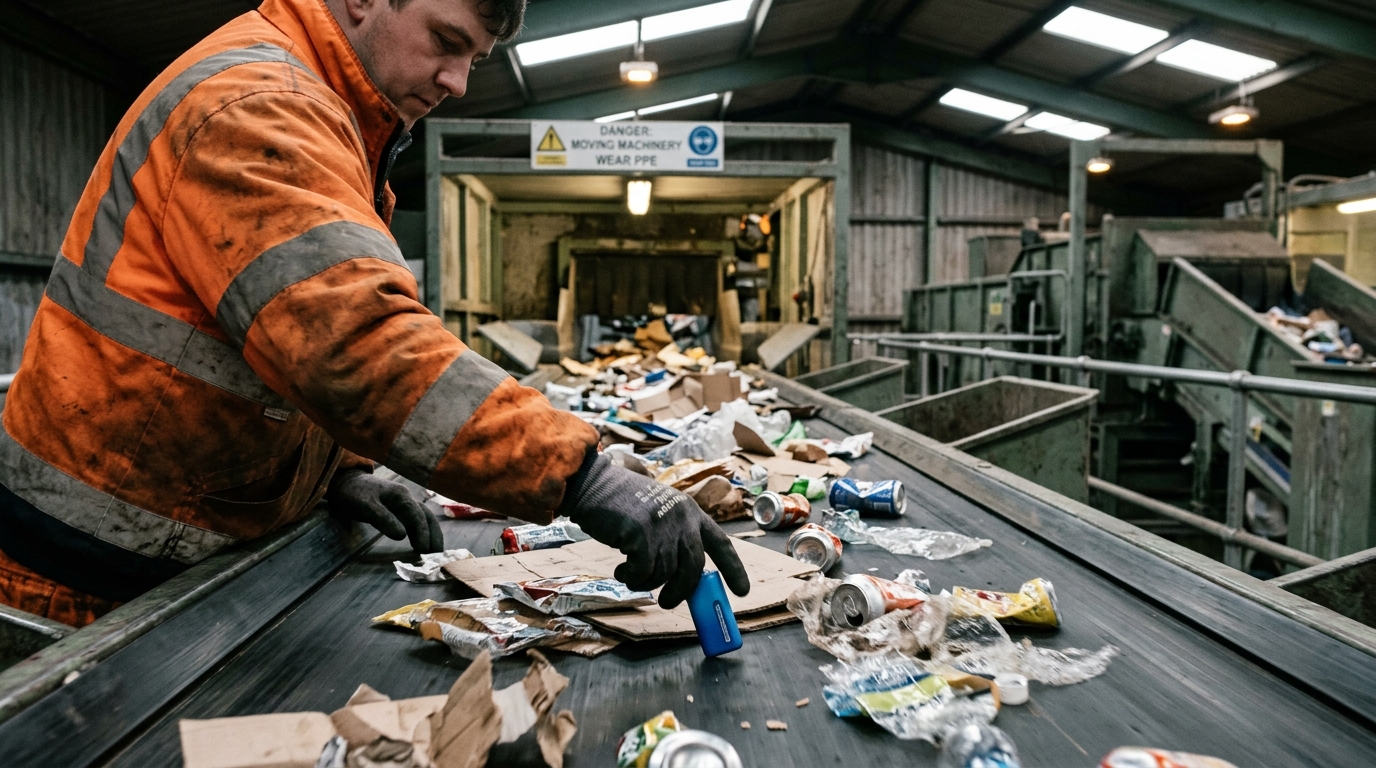
- Brief the pickers and the yard staff. Batteries, vapes, electricals and anything with a battery symbol come off the stream and go to the quarantine point. Toolbox-talk it, do not assume it.
- Slow down where you need to. A belt running too fast to spot a vape is a belt that feeds batteries into the baler. Match throughput to what your pickers can realistically catch.
- Protect the crush points. The grab, the loader bucket, the shear and the baler are where a hidden cell gets punctured. Keep an eye on what is going in and stop if you see a battery.
- Give staff the right kit. Cut-resistant gloves, eye protection and a clear "stop and isolate" instruction. No one should be picking a hot or swollen battery with bare hands.
- Make reporting easy. A near-miss, a smoking item or a swollen pack should be reported the moment it is seen, not at the end of the shift.
Stage 3: how do you segregate and store batteries safely?
Get the removed batteries away from everything that will burn, fast. The point of segregation is distance and containment: a battery that fails in a dedicated store does not take the rest of the yard with it.
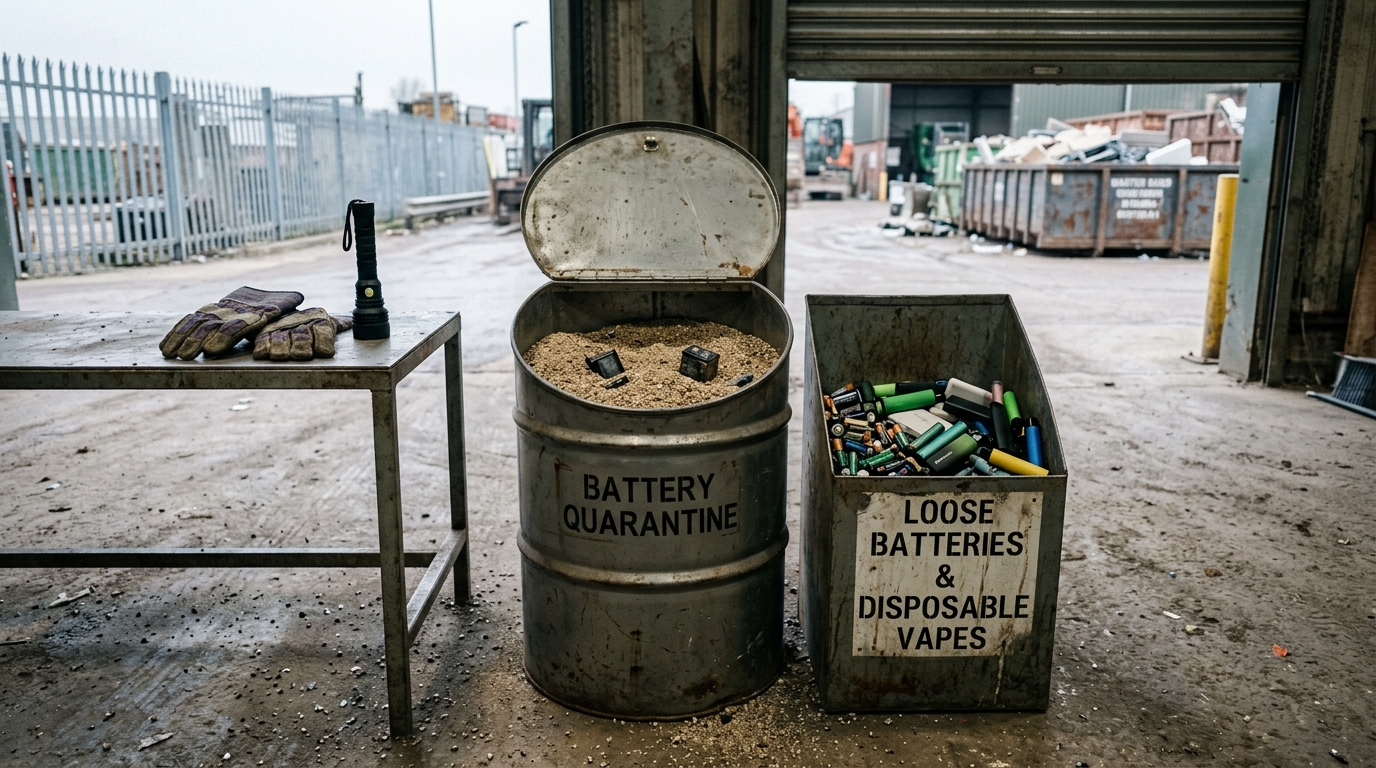
- Have a dedicated collection point. A labelled, non-combustible container for good batteries and vapes, sited away from the main waste and from your buildings.
- Separate by condition. Intact batteries in one container; damaged, swollen, leaking or hot cells go straight to quarantine (Stage 4), not into the general battery bin.
- Keep it non-combustible and covered. Steel containers, kept dry, with a firebreak gap between the battery store and the piles. Water in, no combustibles alongside.
- Do not let it build up. A full battery store is a bigger fire load. Arrange regular collection by a permitted carrier so volumes stay low.
- Map it in your plan. Your Fire Prevention Plan should show where batteries are stored, the separation distances and the maximum you hold. An inspector will check the plan against what is actually on site, which is the heart of any EA inspection checklist for permitted waste sites.
Stage 4: how should you quarantine a damaged or hot battery?
Isolate it the moment it is found, because a damaged cell is the one most likely to ignite. Quarantine is a holding step that buys you time and keeps a failing battery away from fuel.
- Use a quarantine container, not the general bin. A lidded steel drum part-filled with sand or vermiculite lets you bury a damaged cell and smother a small event.
- Site quarantine outdoors and apart. Away from buildings, fuel, other waste and the gate queue, with clear space around it.
- Handle once, carefully. Move a swollen or hot battery as little as possible, with the right PPE, and never into an enclosed space.
- Watch it. A cell that has been crushed can fail hours later. Keep quarantined items under observation until they are collected.
- Have the means to act. Know where your extinguishing media and water supply are, and that your staff can reach them without crossing the hazard.
Stage 5: are you ready for the incident itself?
Assume one will get through, and plan for the first few minutes. Your Fire Prevention Plan is the document that proves you are ready, and it is a permit condition with teeth.
The Environment Agency sets three objectives for the plan: "minimise the likelihood of a fire happening", "aim for a fire to be extinguished within 4 hours", and "minimise the spread of fire within the site and to neighbouring sites" (gov.uk, 2021). A plan is required if you store combustible waste, and "if you do not put in place and use your fire prevention measures, the Environment Agency may take enforcement action" (gov.uk, 2021).
- Know your 4-hour answer. Can you isolate a burning pile, pull material apart and get water on it within four hours? If not, your plan and your kit need work.
- Brief the first response. Who raises the alarm, who calls 999, who meets the brigade, who isolates power. Rehearse it.
- Keep access clear. Fire-service access routes, hydrants and water supplies free and marked.
- Record every event. Every quarantined battery, near-miss and small fire is evidence that your controls work, and that you acted. A dated log of screening, segregation and incidents is exactly what an officer wants to see, and it sits alongside the permit-risk picture in what the EA 10-point plan means for your permit. Capturing those records as the load is handled, rather than rebuilding them from memory at month-end, is where software built for the weighbridge earns its place.
What do your permit and your insurer actually require?
Both now treat batteries as a named risk, so the paperwork and the practice have to line up. In England your Fire Prevention Plan is the document the EA holds you to (gov.uk, 2021). In Wales, Natural Resources Wales requires an equivalent fire prevention and mitigation plan for sites storing combustible waste (Natural Resources Wales).
Insurance is now the other pressure. Battery fires have pushed claims to the point where cover is harder and dearer to find for waste sites. Material Focus notes that "Zurich UK has seen some insurance claims range up to £20 million" (Material Focus, 2024). A documented screening-to-quarantine routine is increasingly what your insurer wants to see before they will quote.
Frequently asked questions
Why are lithium battery fires increasing at waste sites?
More battery-containing products are reaching the waste stream, and too many arrive hidden in the wrong bin or skip. Reported battery fires in bin lorries and at waste sites rose to over 1,200 in a single year, up 71% from 700 in 2022 (Material Focus, 2024).
What share of waste fires do batteries cause?
The ESA estimates lithium-ion batteries are "behind almost half of all waste fires in the UK" (letsrecycle, 2025). Many fires leave little evidence of a cause, so the true share may be higher.
Do I need a Fire Prevention Plan if I store combustible waste?
Yes. The Environment Agency's guidance applies to operators that accept any amount of combustible waste, and a plan must be sent with a permit application involving combustible wastes (gov.uk, 2021).
What are the Fire Prevention Plan's objectives?
To "minimise the likelihood of a fire happening", "aim for a fire to be extinguished within 4 hours", and "minimise the spread of fire within the site and to neighbouring sites" (gov.uk, 2021).
What happens if I do not implement my plan?
"If you do not put in place and use your fire prevention measures, the Environment Agency may take enforcement action" (gov.uk, 2021). The plan has to match what is on the ground, not just sit in a file.
Is the requirement different in Wales?
Yes, the regulator is different. In Wales, Natural Resources Wales requires a fire prevention and mitigation plan for sites storing combustible waste (Natural Resources Wales). The Environment Agency guidance above is for England.
How should I store a damaged or swollen battery?
Isolate it from everything combustible. A common approach is a lidded steel drum part-filled with sand or vermiculite, sited outdoors and away from buildings and other waste, kept under observation until a permitted carrier collects it.
Should I screen loads at the gate or on the line?
Both. Screen at the gate so a battery never reaches the tip, and screen again during handling because the gate will not catch everything. The two filters together are what cut the ignition sources.
Can I just refuse any load with batteries in it?
You can and should refuse loads your permit does not cover, or loads visibly full of battery-containing items you cannot handle. Record the reason. Where a carrier repeatedly brings hidden batteries, treat it as a duty-of-care issue.
How does a battery fire affect my insurance?
It is now a leading reason cover for waste sites is harder and more expensive to obtain; some claims have reached up to £20 million (Material Focus, 2024). A documented screening-and-quarantine routine helps when you come to renew.
Does any of this change what records I keep for the EA?
It adds to them. Keep a dated log of screening, segregation, quarantine and any incident. That evidence supports both your Fire Prevention Plan and your wider inspection readiness, and it is exactly the kind of record an officer asks to see.