The EA Inspection Checklist for Permitted Waste Sites

If you hold an environmental permit, the next EA visit has just got more serious. In its response to the Office for Environmental Protection, the government accepted that the sector's headline compliance figure flatters it: "The 97% metric is masking underperformance" (gov.uk, 2026). It also confirmed new performance indicators "will be introduced in 2027" (gov.uk, 2026).
Translation for the yard: expect tighter, more consistent inspections, not fewer. And the days of an un-visited site coasting on a default top band are ending, because the response states "the Band 'A' default reversion for sites which have not received any inspection needs to be replaced" (gov.uk, 2026).
This is a score-aware EA inspection checklist. It runs through what an officer actually checks, then maps each failing to its Compliance Assessment Report (CAR) risk category, your annual compliance band, and what that band does to next year's permit bill. The point is simple: on a waste site, a tidy inspection is not just good housekeeping, it is money.
Key takeaways
- The EA scores each non-compliance it records against a risk category: category 1 scores 60 points, category 2 scores 31 points, category 3 scores 4 points and category 4 scores 0.1 points (gov.uk, 2026).
- Your points over the compliance year, which runs from 1 January to 31 December, set your band from A (0 points) to F (more than 150 points) (gov.uk, 2026).
- Your band drives your subsistence charge: band A pays 95%, band C pays 110% and band F pays 300% of the baseline (gov.uk, 2026).
- The officer checks your waste acceptance, documentation, storage, fire prevention and duty-of-care records, and from 1 October 2026 your Digital Waste Tracking records are part of that if you receive waste in England or Wales (gov.uk, 2026).
- The EA is now publishing CAR forms online through the Public Register, so a poor assessment is visible to customers and competitors, not just filed away (Environment Agency).
What does an EA officer actually check on a waste site inspection?
An officer checks that you are only accepting what your permit allows, that the paperwork proves it, and that the waste is stored, contained and recorded the way your permit requires. It is a documents-and-eyes exercise: what is on your pad, and what you can show on file.
Work through these before the visit, not during it.
Permit conditions and authorised waste types. The officer starts with your permit. Can you show which waste types and quantities it authorises, and that nothing on site falls outside them? Accepting waste your permit does not cover is one of the fastest ways to turn a routine visit into an enforcement one.
Pre-acceptance and acceptance checks. On receipt, the appropriate-measures guidance is explicit: "You must weigh each load of waste on arrival to confirm the quantities against the accompanying paperwork" and "You must check and validate all transfer documentation and resolve discrepancies before you accept the waste" (gov.uk). If a load does not conform and your permit cannot handle it, you reject it. The officer will want to see that your weighbridge routine actually does this.
Documentation and EWC codes. Every load needs an accurate written description and the correct List of Waste (EWC) code. A wrong code flows through every record downstream, including your DWTS submission. If your gate staff are unsure how to classify a mixed load under time pressure, fix the method first, as we set out in how to pick the right EWC code at the weighbridge.
Authorised storage, containment and drainage. Waste must be stored where, how and in the quantities your permit allows: within marked limits, contained, and with run-off controlled so nothing escapes to drains or ground. Overfilled bays and uncontrolled run-off are classic write-ups.
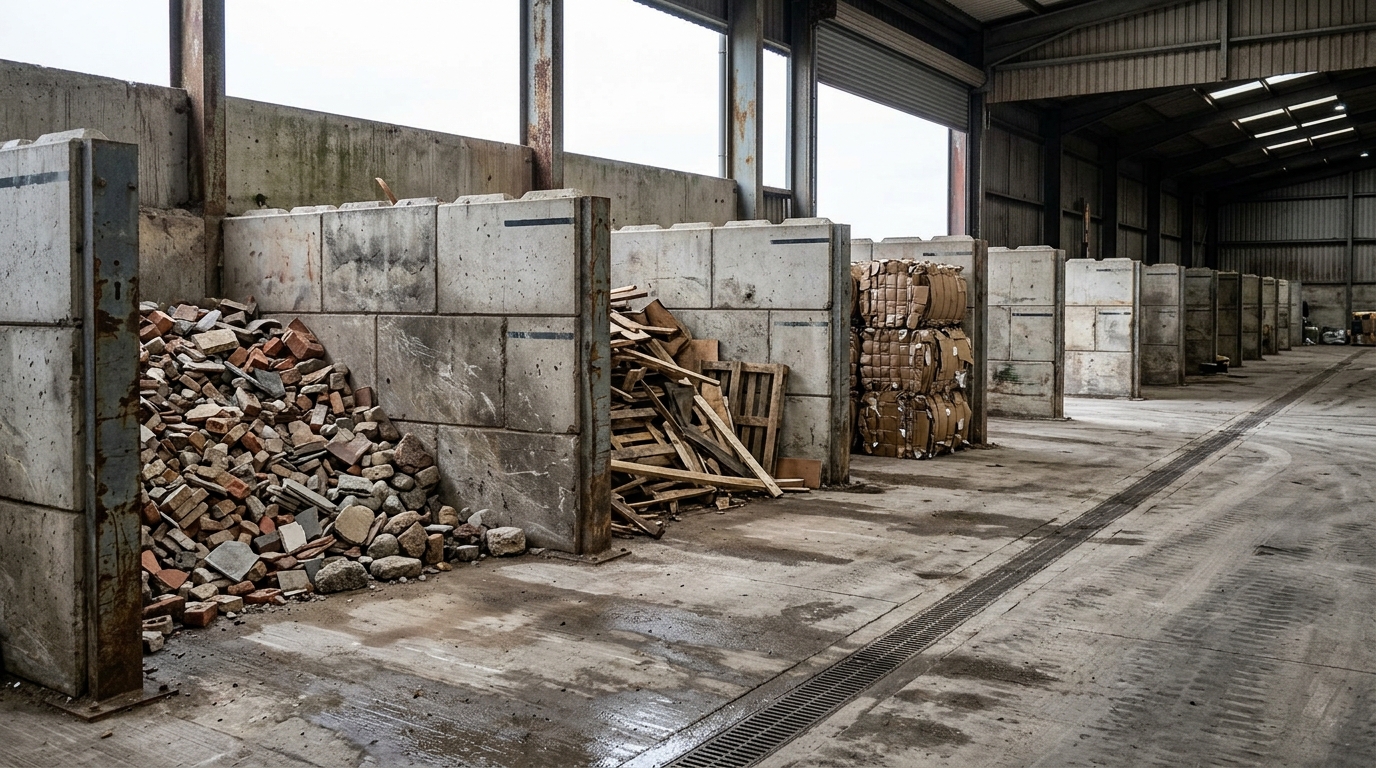
Fire prevention plan. If you keep combustible waste, you need a current plan the officer can read against what is on site. The guidance is direct: "You must use this guidance to make a fire prevention plan if you're storing combustible wastes at sites where you have a permit" (gov.uk).
Duty-of-care records. Your transfer notes, carrier checks and consignment records are the evidence that each load was handled lawfully. Keep waste transfer notes for 2 years (gov.uk). The full spine of this is in our duty of care checklist for waste sites.
Digital Waste Tracking records. From 1 October 2026 this is a live inspection item in England and Wales, covered in its own section below.
Does the inspector now check your Digital Waste Tracking records?
Yes, if you receive waste in England or Wales. From 1 October 2026 the EA expects your loads to be logged in the service, so your DWTS records are now part of the evidence an officer can ask for. The guidance states: "If you receive waste in England or Wales, you must use the service from 1 October 2026" (gov.uk, 2026).
You must "enter details of every load you receive using the 'Report receipt of waste' service" and "submit records within 2 working days (excluding weekends and bank holidays), starting on the day after you receive the waste" (gov.uk, 2026). A backlog of unsubmitted receipts is now a visible gap. Scotland and Northern Ireland follow, with the service "mandatory for receiving site operators in Scotland and Northern Ireland" from January 2027 (gov.uk, 2026).
Note that DWTS does not replace your existing paperwork. You "must continue to complete waste transfer notes, Annex VII forms and hazardous waste consignment notes (where required)" (gov.uk, 2026). The practical fix is to capture the receipt once, at the point of weighing: software built for the weighbridge can file the DWTS record as the load is weighed, so the 2-working-day clock is never the thing that trips you up. For the scheme itself, see what Digital Waste Tracking is.
How does the EA score what it finds?
Every non-compliance the officer records is scored against a risk category, and the category reflects how much harm the failing could cause. The points are fixed: "Risk category 1 non-compliances score 60 points", "Risk category 2 non-compliances score 31 points", "Risk category 3 non-compliances score 4 points" and "Risk category 4 non-compliances score 0.1 points" (gov.uk, 2026).
The categories map to impact: category 1 is a "major impact on human health, quality of life or the environment", category 2 a "significant impact", category 3 a "minor impact" and category 4 "no impact" (gov.uk, 2026). The gap between categories is steep, so one serious failing outweighs a dozen trivial ones.
How does your compliance band affect your permit bill?
Your points over the year set your band, and your band sets your subsistence charge, so a scruffy inspection quietly raises next year's permit bill. Points accumulate over the compliance year, "which runs from 1 January to 31 December" (gov.uk, 2026), and convert to a band: "A = 0 points", "B = 0.1 to 10 points", "C = 10.1 to 30 points", "D = 30.1 to 60 points", "E = 60.1 to 149.9 points" and "F more than 150 points" (gov.uk, 2026).
Sites in "bands A and B have demonstrated an expected level of permit compliance", bands C and D "must improve" and bands E and F "must significantly improve" (gov.uk, 2026). The band then multiplies your charge: "A - 95%", "B - 100%", "C - 110%", "D - 125%", "E - 150%" and "F - 300%" (gov.uk, 2026).
| Band | Points over the year | What it signals | Subsistence charge |
|---|---|---|---|
| A | 0 | Expected compliance | 95% |
| B | 0.1 to 10 | Expected compliance | 100% |
| C | 10.1 to 30 | Must improve | 110% |
| D | 30.1 to 60 | Must improve | 125% |
| E | 60.1 to 149.9 | Must significantly improve | 150% |
| F | more than 150 | Must significantly improve | 300% |
Source: bands, thresholds, meanings and subsistence multipliers, gov.uk, 2026.
Put in the operator's terms: slip from band A to band F and you are paying three times the baseline subsistence, year after year, until you climb back up. That is a standing cost on the business, not a one-off fine. It is why the enforcement climate matters to your margin, as we cover in what the EA's 10-Point Plan means for your permit.
Is your compliance assessment report now public?
Yes. A poor CAR is no longer a private matter between you and your officer. The scoring guidance is clear that once a report is completed, "the law requires us to put it on the Environment Agency's public register" (gov.uk, 2026).
The EA has gone further and is now proactively publishing the forms themselves. It says it "is now publishing CAR forms online through the Public Register Online", and that "CAR forms completed after a set go-live date for that sector will be published online following a 42-day holding period" (Environment Agency). For a waste site, that means a bad inspection is visible to the customers, brokers and competitors who look you up. Treat inspection readiness as reputational as well as regulatory.
The EA inspection checklist at a glance
- Confirm every waste type on site is authorised by your permit, with nothing outside its limits.
- Show your weighbridge weighs each load and validates the paperwork before acceptance, and rejects non-conforming loads.
- Keep an accurate written description and the correct EWC code on every load.
- Store waste within permitted limits, contained, with run-off and drainage controlled.
- Hold a current fire prevention plan if you store combustible waste.
- File duty-of-care evidence and keep waste transfer notes for 2 years.
- Log every received load in DWTS and submit within 2 working days (England and Wales).
- Remember each failing carries a category score that feeds your band and next year's bill.
For the narrative run-up to the visit itself, pair this with our guide on how to prepare for an EA inspection.
Frequently asked questions
What does the EA check on a waste site inspection? It checks that you only accept permitted waste, validate and weigh loads on acceptance, keep accurate descriptions and EWC codes, store waste within limits, hold a fire prevention plan where needed, and keep your duty-of-care and DWTS records. Acceptance checks are set out in the appropriate-measures guidance (gov.uk).
How does the EA score non-compliance? Each recorded non-compliance scores by risk category: 60 points for category 1, 31 for category 2, 4 for category 3 and 0.1 for category 4 (gov.uk, 2026).
What are the EA compliance bands? A is 0 points, B is 0.1 to 10, C is 10.1 to 30, D is 30.1 to 60, E is 60.1 to 149.9 and F is more than 150 points over the compliance year (gov.uk, 2026).
How does my compliance band affect my permit charge? Your band multiplies your subsistence charge: A pays 95%, B 100%, C 110%, D 125%, E 150% and F 300% of the baseline (gov.uk, 2026).
When does the compliance year run? It runs from 1 January to 31 December, and your points accumulate across it (gov.uk, 2026).
Is my CAR score made public? Yes. The law requires the EA to put the assessment on its public register, and it is now publishing CAR forms online after a 42-day holding period (gov.uk, 2026).
Does the inspector check my Digital Waste Tracking records? If you receive waste in England or Wales, yes, from 1 October 2026, when you must use the service and submit records within 2 working days (gov.uk, 2026).
Does DWTS replace my waste transfer notes? No. You must continue to complete waste transfer notes, Annex VII forms and hazardous waste consignment notes where required (gov.uk, 2026).
Do I need a fire prevention plan? You must make one if you store combustible waste at a permitted site (gov.uk).
How long must I keep waste transfer notes? Keep a paper or electronic copy for 2 years (gov.uk).
Why are inspections getting tougher? The government accepted that "the 97% metric is masking underperformance" and is introducing new performance indicators in 2027, so expect more rigorous, more consistent visits (gov.uk, 2026).