7 Waste Transfer Note Mistakes Waste Sites Make (and How to Fix Them)

The transfer note is the one piece of paper that follows every load across your weighbridge, and it is the first thing an Environment Agency officer asks to see. It is also the one most sites fill in on autopilot. When the Scottish regulator checked a batch of them, the picture was blunt: of 91 waste transfer notes checked, 58 did not include the quantity of waste being transferred (SEPA, 2024).
Most transfer-note failures are not exotic. They are the same handful of fields, left blank or filled in badly, load after load. The single most damaging one is a vague waste description: a line like "mixed waste" with no process origin and no specific code breaks the receiving site's duty of care and can route waste to a site not permitted to take it. Below are the seven mistakes that fail a duty-of-care check, and the fix for each.
Key takeaways
- The written description must be good enough "to enable other persons to avoid a contravention" of the law, and the statutory Code says it must be accurate - "mixed waste" does not meet that test (legislation.gov.uk, 1990; gov.uk, 2016).
- Regulation 35 sets every field the note must carry: the EWC code, a description, the quantity and container, the transferor's SIC 2007 code, both parties' details and signatures, and the waste-hierarchy confirmation (legislation.gov.uk, 2011).
- Regulators actively check these notes and fine for incomplete ones: SEPA found 58 of 91 notes missing the quantity and issued £300 penalties (SEPA, 2024).
- Keep transfer notes for at least 2 years and hazardous consignment note records for at least 3 years (legislation.gov.uk, 2011; legislation.gov.uk, 2005).
- From 1 October 2026 the paper note still has to be completed, but the EWC code also becomes a reported digital field for receiving sites in England and Wales (gov.uk, 2026).
The 7 mistakes at a glance
| # | The mistake | The fix |
|---|---|---|
| 1 | A vague or boilerplate waste description | Name the waste, the process it came from and its EWC code |
| 2 | The wrong or a copied EWC code | Classify each load on its own facts, not by habit |
| 3 | Leaving off the quantity or container | Make quantity and container a required box from the weighed figure |
| 4 | Missing the transferor's SIC 2007 code | Record it once per customer and carry it forward |
| 5 | No second signature | Both parties sign before the load is booked in |
| 6 | Transferring to a carrier you never checked | Check the public register and record the registration number |
| 7 | Binning the note too soon | Keep transfer notes 2 years, hazardous consignment records 3 years |
Mistake 1: A vague or boilerplate waste description
The commonest error is the description, and it is the one that does the most harm. The law does not ask for a tidy phrase; it asks for a description good enough that the next holder can handle the waste lawfully. Section 34 requires that there is transferred "such a written description of the waste as will enable other persons to avoid a contravention" of the law (legislation.gov.uk, 1990). The statutory Waste Duty of Care Code of Practice puts the same test plainly: the description of the waste must be accurate (gov.uk, 2016).
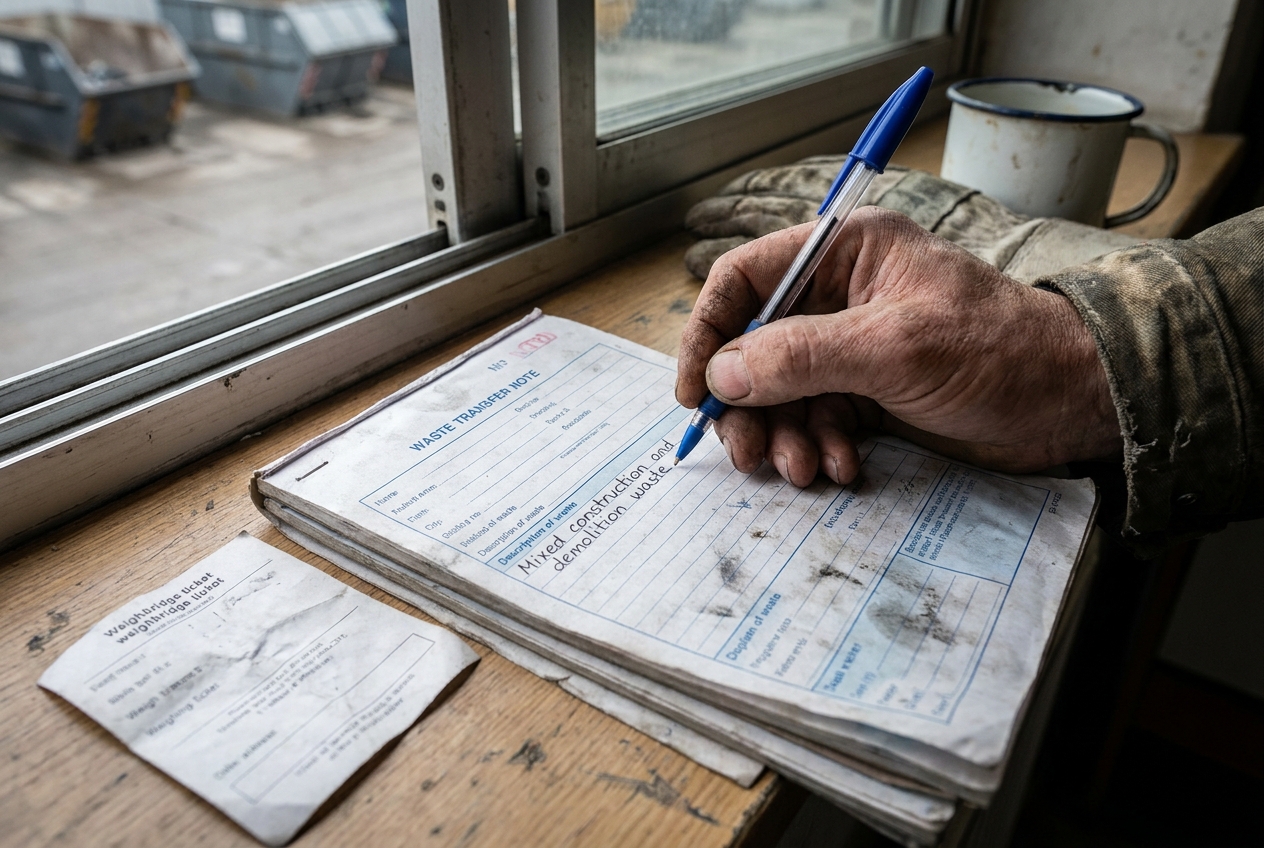
"Mixed waste", "general waste" or the same line copied onto every note does not describe anything. The fix: name what the waste actually is, the process that produced it, and its EWC code, so the description stands on its own. This is also where a waste transfer note earns its place: it is the written description in documentary form, and the description box is the field a regulator reads first.
Mistake 2: The wrong or a copied EWC code
The quickest way to get the code wrong is to copy last time's note without looking at the load. Gov.uk is direct about the duty: "You must identify and classify your waste before you send it for recycling or disposal", and the code on the paperwork is "the waste classification code, also referred to as LoW (List of Waste) code or EWC (European Waste Catalogue) code" (gov.uk, 2024). A copied code assumes this load is the same as the last one, which is often not true.
It gets harder where a waste could be hazardous or not. Some waste items "have more than one classification, depending on the possible mix of substances in them", and you have to work out which applies (gov.uk, 2024). Pick the wrong side of one of those entries and you can send waste to a site not permitted to accept it. The fix: classify each load on its own facts, not by habit. For the detail on how to do that at the weighbridge, see how to pick the right EWC code and the specific EWC code mistakes that catch sites out.
Mistake 3: Leaving off the quantity or how the waste is contained
This is the field SEPA found missing more than any other. Regulation 35 is not optional on it: the note must state the quantity of the waste and whether it is loose or in a container, and if in a container, the kind of container (legislation.gov.uk, 2011). A note that says what the waste is but not how much of it moved is an incomplete note.
The fix: make the quantity and container a required box the weighbridge cannot skip - the weighed figure is already on the ticket, so the number exists; it just has to land on the note. Both companies in that SEPA case were given £300 penalties for failing to complete their notes correctly (SEPA, 2024).
Mistake 4: Missing the transferor's SIC 2007 code
The one field people forget exists. Regulation 35 requires the SIC code of the transferor on the note - the Standard Industrial Classification (SIC) 2007 code for the business (legislation.gov.uk, 2011). It identifies the business activity the waste came from, and it is a straightforward thing to leave blank because it rarely changes for a regular customer.
The fix: record the SIC 2007 code once per regular transferor and carry it forward, rather than leaving the box empty each time. For a one-off customer, ask for it at the gate before the load is accepted. It is a small field, but a missing one makes the note incomplete in exactly the way a compliance check looks for.
Mistake 5: No second signature, so the hierarchy declaration is unconfirmed
A transfer note is a two-party document, and a single signature does not finish it. Regulation 35 requires the note to be signed by or on behalf of both the transferor and the transferee, and to confirm that the transferor has discharged the waste-hierarchy duty in regulation 12 (legislation.gov.uk, 2011). When the receiving site does not sign, that confirmation is left hanging and the note is not evidence of a completed, compliant transfer.
The fix: build the second signature into the gate routine, so no load is booked in until the note is signed on both sides. On a busy weighbridge it is tempting to wave the lorry through and "sort the paperwork later", but later is when it gets forgotten.
Mistake 6: Transferring to a carrier you never checked
The duty of care does not end when the waste leaves your pad; it includes who you hand it to. The Code of Practice is explicit: "You should check whether a person or business is authorised to take waste before you transfer your waste to them", and you can verify a carrier on the public register (gov.uk, 2016). A valid note handed to an unregistered carrier still puts you in breach.
The fix: check the carrier's registration on the Environment Agency public register on the first collection and when it is due to expire, and record the registration number on the note, as regulation 35 expects for a party acting as a carrier (legislation.gov.uk, 2011). A quick check at the gate is cheaper than being the last traceable holder of a load that is later fly-tipped.
Mistake 7: Binning the note before the retention period is up
Completing the note correctly is only half the duty; you also have to keep it. For a waste transfer note the Code gives the figure as 2 years for non-hazardous waste (gov.uk, 2016), and regulation 35 adds the sharper obligation: you must produce the note to an Environment Agency or waste collection authority officer within 7 days of a demand (legislation.gov.uk, 2011). Hazardous waste is kept longer: records must be held "for 3 years after the date on which the waste is transferred to another person" (legislation.gov.uk, 2005).
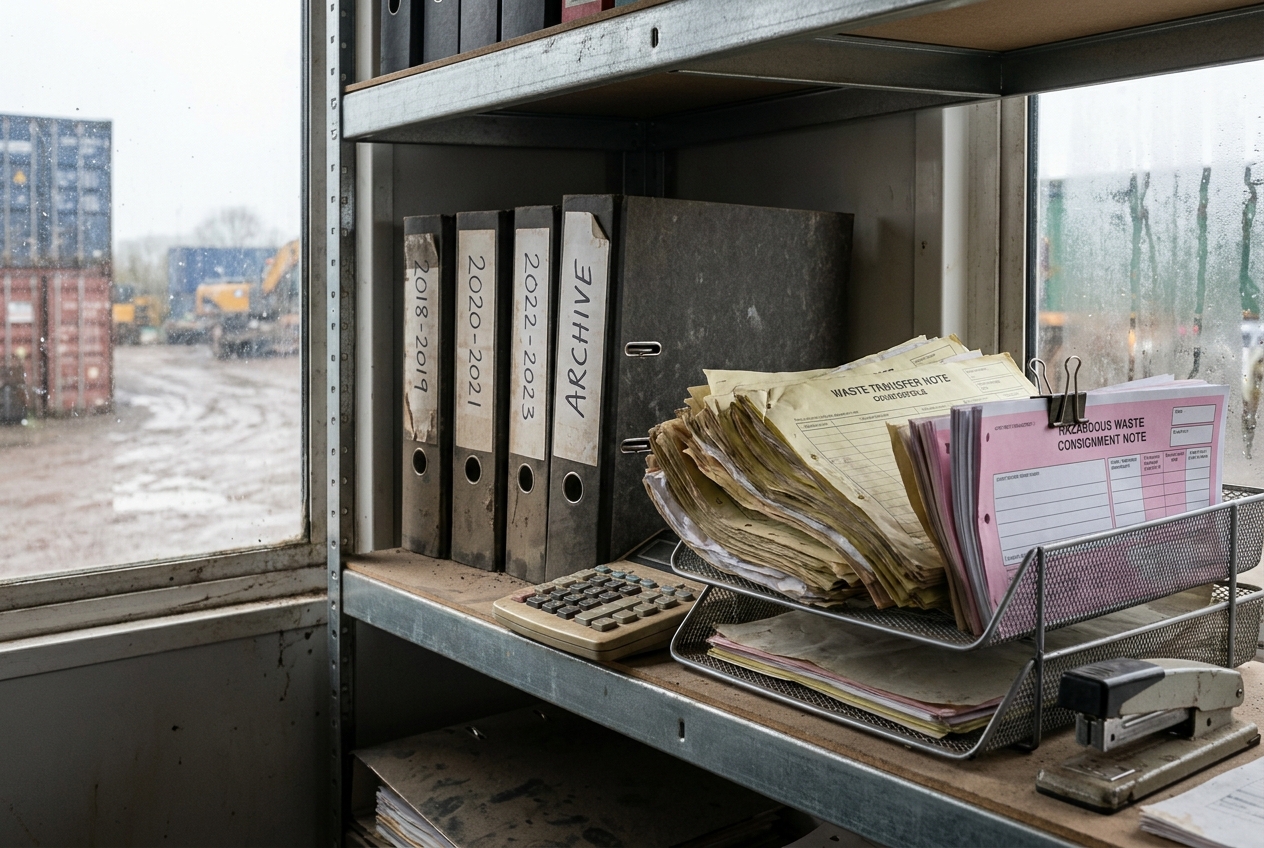
The fix: file every note the day it is raised, by year, and never clear the current or previous two years off the shelf. A note you completed perfectly but cannot find on the day is treated the same as one you never had.
How digital waste tracking changes this from 1 October 2026
The paper note is not going away, and that trips sites up in both directions. From 1 October 2026, receiving sites in England and Wales "must use the service" for digital waste tracking, but gov.uk is clear that you "must continue to complete waste transfer notes, Annex VII forms and hazardous waste consignment notes (where required)" (gov.uk, 2026). The paper and the digital record run together, so a sloppy note now also feeds a sloppy digital report. For how the two sit side by side, see whether you still need paper transfer notes and what records you still keep after digital waste tracking.
The practical change is that the EWC code and the core transfer details become fields you report digitally, within 2 working days of receiving the load (gov.uk, 2026). A wrong code that used to sit unnoticed on a paper note now has somewhere more visible to go wrong. Software built for the weighbridge can capture the description, the code and the carrier check once as the load is weighed, so the note and the digital record cannot drift apart. The dates differ by nation, though: in Scotland and Northern Ireland digital waste tracking "becomes mandatory in January 2027", not October 2026 (NetRegs, 2026).
What getting the transfer note wrong actually costs
There are two penalties, and they sit at different scales. The direct one is a fixed penalty: where a person has failed to produce the waste documents an enforcement authority asks for, "the fixed penalty payable to an enforcement authority under this section is, subject to subsection (10) below, £300" (section 34A) (legislation.gov.uk, 1990). It lands for the simplest failure of all: paperwork you cannot produce on the day.
The larger one is the duty-of-care offence itself. Breaching the section 34 duty is punishable "on summary conviction, to a fine not exceeding the statutory maximum" and "on conviction on indictment, to a fine" with no upper limit (legislation.gov.uk, 1990). Regulators do act on this: alongside the Glasgow and Lochgelly case, a Rothesay operator was given a £300 penalty for failing to complete waste transfer notes correctly (SEPA, 2025). For most sites, though, the real cost is the write-up on the compliance assessment report, which rolls into the annual compliance band and quietly raises next year's permit charge.
Frequently asked questions
What is the most common mistake on a waste transfer note? A vague or boilerplate waste description. The law requires a description good enough to let the next holder avoid breaking the law, and the Code says it must be accurate, so "mixed waste" or a copied line fails the test (legislation.gov.uk, 1990; gov.uk, 2016).
What makes a waste description compliant? It names what the waste actually is, the process it came from and its EWC code, so the next holder can handle it lawfully without guessing (legislation.gov.uk, 1990).
What must a waste transfer note contain? The waste's List of Waste (EWC) code, a description, the quantity and container type, the time and place of transfer, the transferor's SIC 2007 code, both parties' names, addresses and signatures, each party's capacity with any permit or registration number, and confirmation of the regulation 12 hierarchy duty (legislation.gov.uk, 2011).
Why does the SIC code have to be on the note? Regulation 35 requires the transferor's SIC 2007 code, which identifies the business activity the waste came from. Leaving it blank makes the note incomplete (legislation.gov.uk, 2011).
Do both parties have to sign the transfer note? Yes. The note must be signed by or on behalf of both the transferor and the transferee, and that is also what confirms the regulation 12 waste-hierarchy duty has been met (legislation.gov.uk, 2011).
How do I check a waste carrier is authorised? Check their registration on the Environment Agency public register before the first transfer, as the Code of Practice advises, and record the registration number on the note (gov.uk, 2016).
How long do I keep a waste transfer note? At least 2 years for a transfer note, and you must produce it within 7 days if an officer asks. Hazardous waste consignment note records are kept for at least 3 years (legislation.gov.uk, 2011; legislation.gov.uk, 2005).
What is the fine for an incorrect or missing transfer note? A £300 fixed penalty under section 34A for failing to produce the documents, and, for breaching the duty of care itself, a fine up to the statutory maximum on summary conviction or an unlimited fine on indictment (legislation.gov.uk, 1990; legislation.gov.uk, 1990).
Does digital waste tracking replace the paper transfer note? No. From 1 October 2026 receiving sites in England and Wales must use the digital service, but you must continue to complete transfer notes, Annex VII forms and hazardous consignment notes where required (gov.uk, 2026).
When does digital waste tracking start in Scotland and Northern Ireland? It becomes mandatory in January 2027 for receiving sites, not October 2026 as in England and Wales (NetRegs, 2026).
Can one wrong EWC code really matter? Yes. Some wastes have more than one classification depending on what is in them, so a copied or guessed code can send a load to a site not permitted to accept it (gov.uk, 2024).